Reactogenicity: Difference between revisions
CSV import |
CSV import |
||
| Line 28: | Line 28: | ||
{{Immunology-stub}} | {{Immunology-stub}} | ||
{{Pharma-stub}} | {{Pharma-stub}} | ||
== Reactogenicity == | |||
<gallery> | |||
File:41541 2019 132 Fig1 HTML.webp|Reactogenicity | |||
File:41541 2019 132 Fig2 HTML.webp|Reactogenicity | |||
</gallery> | |||
Revision as of 00:35, 20 February 2025
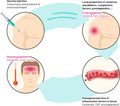
Reactogenicity refers to the property of a vaccine or other therapeutic intervention to produce adverse reactions, particularly immediate reactions. It is a common term used in immunology and vaccinology to describe the physical manifestation of the inflammatory response to vaccination.
Definition
Reactogenicity is defined as the physical manifestation of the inflammatory response to vaccination. It is a common term used in immunology and vaccinology. Reactogenicity is not the same as vaccine adverse events, which are any untoward medical occurrence that follows immunization but does not necessarily have a causal relationship with the usage of the vaccine.
Types of Reactions
Reactogenicity can be local or systemic. Local reactions are those that occur at the site of injection, such as pain, swelling, or redness. Systemic reactions are those that affect the entire body, such as fever, fatigue, headache, muscle pain, chills, diarrhea, and vomiting.
Factors Influencing Reactogenicity
Several factors can influence the reactogenicity of a vaccine, including the vaccine formulation, the route of administration, the dose, the age of the recipient, and the recipient's immune status.
Management of Reactogenicity
Reactogenicity is generally self-limited and can be managed with symptomatic treatment. In some cases, non-steroidal anti-inflammatory drugs (NSAIDs) or paracetamol may be used to manage symptoms.
See Also
- Vaccine
- Immunology
- Vaccinology
- Adverse event
- Local reactions
- Systemic reactions
- Non-steroidal anti-inflammatory drugs
- Paracetamol

This article is a immunology stub. You can help WikiMD by expanding it!

Reactogenicity
-
 Reactogenicity
 -
 Reactogenicity


