Shrimp paste: Difference between revisions
CSV import |
CSV import |
||
| Line 42: | Line 42: | ||
{{food-stub}} | {{food-stub}} | ||
{{Asia-food-stub}} | {{Asia-food-stub}} | ||
== Shrimp_paste == | |||
<gallery> | |||
File:A_square_of_shrimp_paste_from_Hung_Kee_store.jpg|A square of shrimp paste from Hung Kee store | |||
File:Drying_shrimp_paste.jpg|Drying shrimp paste | |||
File:Shrimp.paste-Belachan-01.jpg|Shrimp paste Belachan | |||
File:Ginisang_alamang_(sauteed_shrimp_paste)_-_Philippines.jpg|Ginisang alamang (sauteed shrimp paste) - Philippines | |||
File:Philippine_shrimp_paste.jpg|Philippine shrimp paste | |||
File:Burong_Hipon_3.jpg|Burong Hipon | |||
File:Belachan_or_Terasi_Bangka.jpg|Belachan or Terasi Bangka | |||
File:Kapi_chiang_mai_warorot_market_01.jpg|Kapi Chiang Mai Warorot Market | |||
</gallery> | |||
Latest revision as of 11:07, 25 February 2025
Shrimp paste or shrimp sauce is a fermented condiment commonly used in Southeast Asian, Northeastern South Asian and Southern Chinese cuisines. It is primarily made from finely crushed shrimp or krill mixed with salt, and then fermented for several weeks. They are either sold in their wet form or are sun-dried and cut into blocks for sale.
History[edit]
The use of shrimp paste in Asian cooking is believed to date back to the 16th century, when it was first used as a flavor enhancer in Chinese cuisine. It was later adopted by other Asian cultures, including those in Thailand, Vietnam, Malaysia, and the Philippines.
Production[edit]
Shrimp paste is made by fermenting ground shrimp with salt. The mixture is left to ferment for a few weeks, during which time it develops a strong, pungent smell. After fermentation, the paste is usually sun-dried, which helps to intensify its flavor. In some regions, the paste is instead roasted or smoked.
Uses[edit]
Shrimp paste is used as a flavoring in a variety of dishes, including curries, soups, and stir-fries. It is also used as a base for many sauces and dips. In some cultures, shrimp paste is even used as a spread on bread or crackers.
Varieties[edit]
There are many different varieties of shrimp paste, each with its own unique flavor profile. Some of the most popular include:
- Belacan: A Malaysian shrimp paste that is typically toasted before use.
- Bagoong: A Filipino shrimp paste that is often pink in color and has a slightly sweet flavor.
- Mam tom: A Vietnamese shrimp paste that is typically used as a dipping sauce.
- Kapi: A Thai shrimp paste that is used in a variety of dishes, including the popular green papaya salad.
Health Benefits and Risks[edit]
Shrimp paste is high in protein and contains a variety of vitamins and minerals. However, it is also high in sodium, which can contribute to high blood pressure and other health problems if consumed in excess.
See Also[edit]
References[edit]
<references />

This Asia-food related article is a stub. You can help WikiMD by expanding it.
Shrimp_paste[edit]
-
 A square of shrimp paste from Hung Kee store
 -
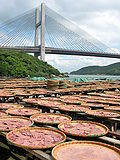 Drying shrimp paste
 -
Shrimp paste Belachan
-
Ginisang alamang (sauteed shrimp paste) - Philippines
-
Philippine shrimp paste
-
Burong Hipon
-
Belachan or Terasi Bangka
-
Kapi Chiang Mai Warorot Market


_-_Philippines.jpg)


