Sumer: Difference between revisions
CSV import Tags: mobile edit mobile web edit |
CSV import |
||
| Line 24: | Line 24: | ||
{{Ancient Near East}} | {{Ancient Near East}} | ||
{{Civilization-stub}} | {{Civilization-stub}} | ||
<gallery> | |||
File:Sumer_satellite_map.jpg|Sumer | |||
File:Head_of_Gudea_(Metropolitan_Museum_of_Art).jpg|Head of Gudea | |||
File:Saĝ-gíg_(cuneiforms).jpg|Saĝ-gíg (cuneiforms) | |||
File:Saĝ_(linear_script,_head).jpg|Saĝ (linear script, head) | |||
File:Saĝ_(Sumero-Akkadian_cuneiform,_head).jpg|Saĝ (Sumero-Akkadian cuneiform, head) | |||
File:Gíg_(linear_script,_night-black).jpg|Gíg (linear script, night-black) | |||
File:Gíg_(Sumero-Akkadian_cuneiform,_night-black).jpg|Gíg (Sumero-Akkadian cuneiform, night-black) | |||
File:Blau_Monuments_(front).jpg|Blau Monuments (front) | |||
File:Enthroned_King_of_Ur.jpg|Enthroned King of Ur | |||
File:Proto-cuneiform_Cities_list.svg|Proto-cuneiform Cities list | |||
File:The_White_Temple_'E_at_Uruk,_3500-3000_BCE.jpg|The White Temple 'E at Uruk, 3500-3000 BCE | |||
File:White_Temple_ziggurat_in_Uruk.jpg|White Temple ziggurat in Uruk | |||
</gallery> | |||
Revision as of 11:41, 18 February 2025
Sumer was an ancient civilization and historical region located in southern Mesopotamia, modern-day southern Iraq. It is considered one of the earliest civilizations in the world, dating back to the 5th millennium BC.
History
Sumer was established by the Ubaid people, who are credited with developing irrigation, agriculture, and the first form of urban civilization in the region. The Sumerians are known for their advancements in various fields such as writing, law, architecture, and astronomy.
Early Period
The Early Dynastic Period of Sumer, starting around 2900 BC, saw the development of many city-states, each with its own king. These city-states often fought each other for control of the fertile land and water resources. The most powerful city-states during this period were Uruk, Lagash, and Ur.
Middle Period
The Akkadian Empire, established by Sargon of Akkad, conquered Sumer around 2334 BC. This period is known for the development of the Akkadian language, which became the lingua franca of the region.
Late Period
The Third Dynasty of Ur, also known as the Neo-Sumerian Empire, marked the last great period of Sumerian dominance in Mesopotamia. This period saw a revival of Sumerian culture and language, but it eventually fell to the Elamites and the Amorites.
Culture
Sumerian culture was rich and complex, with a pantheon of gods, a detailed mythological tradition, and a highly developed system of writing known as cuneiform. Sumerians are also known for their advancements in law, with the Code of Ur-Nammu being one of the earliest known law codes.
Legacy
The legacy of Sumer is vast, influencing subsequent civilizations in the region and beyond. Many aspects of modern society, such as writing, law, and urban living, can be traced back to Sumer.
| Timeline of the Ancient Near East |
|---|
|
* Category
|
-
 Sumer
Sumer -
 Head of Gudea
 -
 Saĝ-gíg (cuneiforms)
 -
 Saĝ (linear script, head)
 -
 Saĝ (Sumero-Akkadian cuneiform, head)
 -
 Gíg (linear script, night-black)
 -
 Gíg (Sumero-Akkadian cuneiform, night-black)
 -
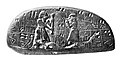 Blau Monuments (front)
 -
 Enthroned King of Ur
 -
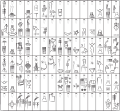 Proto-cuneiform Cities list
 -
 The White Temple 'E at Uruk, 3500-3000 BCE
 -
 White Temple ziggurat in Uruk

.jpg)
.jpg)
.jpg)
.jpg)
.jpg)
.jpg)
.jpg)


