Parvoviridae: Difference between revisions
CSV import Tags: mobile edit mobile web edit |
CSV import |
||
| Line 37: | Line 37: | ||
[[Category:Parvoviruses]] | [[Category:Parvoviruses]] | ||
{{Virus-stub}} | {{Virus-stub}} | ||
<gallery> | |||
File:Canines_Parvovirus.jpg|Canine Parvovirus | |||
File:Parvoviridae_virion.jpg|Parvoviridae Virion | |||
File:4dpv.jpg|Parvoviridae | |||
File:B19_virus.png|B19 Virus | |||
</gallery> | |||
Latest revision as of 04:50, 18 February 2025
Parvoviridae is a family of small, rugged, genetically-compact DNA viruses. Members of this family are known as parvoviruses. This family has been divided into two subfamilies: Parvovirinae and Densovirinae. Parvovirinae infect vertebrates, while Densovirinae infect invertebrates.
Structure[edit]
Parvoviruses are non-enveloped and possess an icosahedral capsid. The capsid is made up of 60 capsomers and has a diameter of 18-26 nanometers. The capsid surrounds a single-stranded DNA genome that is approximately 5 kilobases in length.
Genome[edit]
The genome of parvoviruses is linear, non-segmented and contains a single molecule of single-stranded DNA. The complete genome is 4000-6000 nucleotides long. The genome has two ends, each of which forms a hairpin loop that serves as the origin of DNA replication.
Replication[edit]
Parvoviruses replicate in the nucleus of the host cell. The replication process involves the formation of a double-stranded DNA intermediate, which serves as a template for transcription. The replication of the viral genome is dependent on the host cell's DNA synthesis machinery.
Pathogenesis[edit]
Parvoviruses are known to cause a variety of diseases in animals. For example, Canine parvovirus causes a severe and often fatal disease in dogs, while Feline panleukopenia virus causes a similar disease in cats. In humans, Parvovirus B19 is known to cause Fifth disease, a common childhood ailment.
Prevention and Control[edit]
Vaccines are available for some parvoviruses, such as Canine parvovirus and Feline panleukopenia virus. In the case of Parvovirus B19, prevention is primarily through good hygiene practices, as there is currently no vaccine available.
See Also[edit]
References[edit]
<references />

-
 Canine Parvovirus
 -
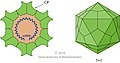 Parvoviridae Virion
 -
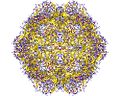 Parvoviridae
 -
 B19 Virus


