Photoperiodism: Difference between revisions
CSV import |
CSV import |
||
| Line 29: | Line 29: | ||
[[Category:Animal physiology]] | [[Category:Animal physiology]] | ||
{{biology-stub}} | {{biology-stub}} | ||
<gallery> | |||
File:Photoperiodism_in_plants.jpg|Photoperiodism in plants | |||
File:Long_Day_Plants.jpg|Long day plants | |||
File:Short_Day_Plants.jpg|Short day plants | |||
</gallery> | |||
Latest revision as of 01:05, 18 February 2025
Photoperiodism is a biological response of organisms to the length of day or night. It is a critical factor in the control of seasonal activities in both plants and animals. The concept of photoperiodism was first described by Garnett Thomas Morgan in 1920.
Overview[edit]
Photoperiodism is the physiological reaction of organisms to the length of day or night. It is vital in determining the seasonal activities of plants and animals. Photoperiodism does not depend on the intensity of light but on the duration of light and dark periods within a 24-hour cycle.
Mechanism[edit]
The mechanism of photoperiodism involves the perception of day length by a photoreceptor molecule, which then triggers a signal transduction pathway leading to a physiological response. In plants, the photoreceptor is a blue-light receptor called cryptochrome. In animals, the photoreceptor is typically located in the pineal gland.
In Plants[edit]
In plants, photoperiodism regulates flowering time, leaf fall, and the onset of winter dormancy. Plants are classified into three types based on their response to photoperiod: short-day plants, long-day plants, and day-neutral plants.
In Animals[edit]
In animals, photoperiodism influences the timing of reproduction, migration, and winter preparation. Animals use changes in day length as a calendar to anticipate changes in the environment associated with different seasons.
See Also[edit]

-
 Photoperiodism in plants
 -
 Long day plants
 -
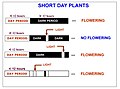 Short day plants


