Juglans regia: Difference between revisions
CSV import Tags: mobile edit mobile web edit |
CSV import |
||
| Line 19: | Line 19: | ||
{{trees-stub}} | {{trees-stub}} | ||
{{nut-stub}} | {{nut-stub}} | ||
<gallery> | |||
File:Oldest_Walnut_tree_in_the_world._Khotan,_Xinjiang.jpg|Oldest walnut tree in the world, Khotan, Xinjiang | |||
File:Juglans_regia_-_Köhler–s_Medizinal-Pflanzen-081.jpg|Juglans regia illustration from Köhler's Medizinal-Pflanzen | |||
</gallery> | |||
Latest revision as of 04:15, 18 February 2025
Juglans regia, commonly known as the Persian walnut, English walnut, Carpathian walnut, or Common walnut, is a species of walnut native to the region stretching from the Balkans eastward to the Himalayas and southwest China. It is widely cultivated across Europe.
Description[edit]
Juglans regia is a large, deciduous tree attaining heights of 25–35 m, and a trunk up to 2 m diameter, commonly with a short trunk and broad crown. The bark is smooth, olive-brown when young and silvery-grey on older branches. The leaves are alternately arranged, 25–40 cm long, odd-pinnate with 5–9 leaflets. The largest leaflets are the three at the apex, 10–18 cm long and 6–8 cm broad; the basal pair of leaflets are much smaller, 5–8 cm long. The male flowers are in drooping catkins 5–10 cm long, and the female flowers are terminal, in clusters of two to five, ripening in the autumn into a fruit with a green, semi-fleshy husk and a brown, corrugated nut.
Cultivation and uses[edit]
The Juglans regia tree produces high-quality timber and is widely cultivated for its delicious and nutritious nuts. The nuts are rich in oil, and are widely eaten both fresh and in cookery. Walnut oil is expensive and consequently is used sparingly; most often in salad dressing. Walnuts are also an excellent source of omega-3 fatty acids, and have been shown to have considerable health benefits.
History[edit]
The Juglans regia is believed to have been cultivated in Europe from at least 1000 BC. The Greek botanist, Theophrastus, wrote about the walnut in the fourth century BC; he said that the Greeks called it the 'Persian Nut' because the Persians ate it in large quantities.
Conservation[edit]
While Juglans regia is widely cultivated, it is considered endangered in its native range due to habitat loss and over-exploitation. Conservation efforts are underway to protect this valuable species.
This tree-related article is a stub. You can help WikiMD by expanding it.
This nut-related article is a stub. You can help WikiMD by expanding it.
-
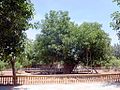 Oldest walnut tree in the world, Khotan, Xinjiang
 -
 Juglans regia illustration from Köhler's Medizinal-Pflanzen


