HOT-17: Difference between revisions
CSV import Tags: mobile edit mobile web edit |
CSV import |
||
| Line 24: | Line 24: | ||
[[Category:Substituted phenethylamines]] | [[Category:Substituted phenethylamines]] | ||
{{Psychoactive-stub}} | {{Psychoactive-stub}} | ||
<gallery> | |||
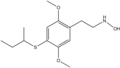
File:HOT-17.png|HOT-17 | |||
</gallery> | |||
Latest revision as of 05:45, 3 March 2025
HOT-17 is a psychedelic drug and a member of the phenethylamine family. It is related to the more well-known compounds 2C-E and DOB. HOT-17 was first synthesized and studied by the team led by Alexander Shulgin.
Chemistry[edit]
HOT-17, or 2,5-dimethoxy-4-(β-isohexyl)-phenethylamine, is a substituted phenethylamine featuring a phenyl ring bound to an amino (NH2) group through an ethyl chain. HOT-17 shares this phenethylamine structure with other psychedelic drugs like mescaline and 2C-B.
Pharmacology[edit]
The pharmacological mechanisms of HOT-17 are not well understood. It is believed to act as a 5-HT2A receptor agonist, similar to other psychedelic phenethylamines. However, the exact nature of its interactions with the 5-HT2A receptor and other potential targets is not known.
Effects[edit]
The effects of HOT-17 are largely unknown due to the lack of scientific research. Anecdotal reports suggest that it produces effects similar to other psychedelic phenethylamines, including open and closed-eye visuals, time distortion, enhanced introspection, and altered auditory and visual perception.
Legality[edit]
The legality of HOT-17 varies by country. In the United States, it is not specifically listed as a controlled substance, but it could potentially be considered an analog of DOB, which is a Schedule I drug under the Controlled Substances Act.
See also[edit]

This article is a psychoactive drug-related stub. You can help WikiMD by expanding it!
-
 HOT-17

