Fire triangle: Difference between revisions
CSV import |
CSV import |
||
| Line 33: | Line 33: | ||
[[Category:Firefighting]] | [[Category:Firefighting]] | ||
{{Fire-stub}} | {{Fire-stub}} | ||
<gallery> | |||
File:Fire_triangle.svg|Fire triangle diagram | |||
File:Fire_tetrahedron.svg|Fire tetrahedron diagram | |||
File:Fire_Triangles.jpg|Fire triangles illustration | |||
</gallery> | |||
Latest revision as of 01:30, 18 February 2025
Fire Triangle
The Fire Triangle or Combustion Triangle is a simple model for understanding the necessary ingredients for most fires. It illustrates the three elements a fire needs to ignite: heat, fuel, and an oxidizing agent (usually oxygen). A fire naturally occurs when the elements are present and combined in the right mixture.
Heat[edit]
Heat is the energy component of the fire triangle. It is needed to start and continue the chemical reaction of combustion. Heat can be transferred from one body to another in three ways: conduction, convection, and radiation. In the context of fire, heat is both a product of and a necessary condition for combustion.
Fuel[edit]
Fuel in the fire triangle refers to any kind of combustible material. This can range from wood and paper, to flammable gases like propane and natural gas, to combustible metals like magnesium. The fuel is the substance that gets oxidized or burned in the combustion process.
Oxidizing Agent[edit]
The oxidizing agent in a fire triangle is typically oxygen in the Earth's atmosphere. The oxygen reacts with the fuel in a chemical reaction that produces heat, light, and new products. Other oxidizing agents include fluorine, chlorine, and nitrous oxide.
Fire Tetrahedron[edit]
The Fire Tetrahedron is a more advanced model that adds a fourth element to the fire triangle: the chemical chain reaction. This model is used to understand more complex fire scenarios, such as those involving flammable liquids or gases.
Fire Control[edit]
Understanding the fire triangle is essential for fire control. By removing or preventing any one of the elements, a fire can be prevented or extinguished. For example, water can be used to remove heat, a fire blanket can be used to remove oxygen, and removing fuel can stop a fire from spreading.
See Also[edit]

-
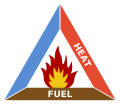 Fire triangle diagram
 -
 Fire tetrahedron diagram
 -
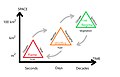 Fire triangles illustration


