CS gas: Difference between revisions
CSV import |
CSV import |
||
| Line 27: | Line 27: | ||
{{Riot control weapons}} | {{Riot control weapons}} | ||
{{Chem-weapon-stub}} | {{Chem-weapon-stub}} | ||
<gallery> | |||
File:CS_gas.svg|CS gas chemical structure | |||
File:CS-gas-3D-vdW.png|3D model of CS gas | |||
File:CS-Gas-Synthese.svg|Synthesis of CS gas | |||
File:Tear_gas_shells_used_in_istanbul_in_2013.jpg|Tear gas shells used in Istanbul in 2013 | |||
</gallery> | |||
Latest revision as of 04:50, 18 February 2025
CS gas, also known as 2-chlorobenzalmalononitrile or tear gas, is a compound commonly used in riot control and self-defense. It is a member of the chemical weapons family, specifically a type of lachrymatory agent, which causes severe eye and respiratory pain, skin irritation, bleeding, and even blindness.
History[edit]
CS gas was first synthesized by two American scientists, Ben Corson and Roger Stoughton, at Middlebury College in 1928. The compound's name "CS" is derived from the initials of these two scientists. It was first used in a law enforcement context in the United States in the 1950s and 1960s.
Chemical Properties[edit]
CS gas is a white crystalline powder with a peppery odor. It is insoluble in water but can be dissolved in organic solvents. When heated or exposed to moisture, it decomposes to produce hydrogen cyanide, a highly toxic compound.
Effects[edit]
Exposure to CS gas causes a burning sensation in the eyes, nose, mouth, and throat, accompanied by excessive tearing, coughing, and difficulty breathing. These effects typically begin within seconds of exposure and can last up to an hour. Prolonged exposure can lead to more serious health effects, including chemical burns, allergic reactions, and in rare cases, death.
Use in Law Enforcement[edit]
CS gas is widely used by law enforcement agencies around the world for riot control. It is typically dispersed using grenades or aerosol cans. Despite its widespread use, the use of CS gas in warfare is prohibited by the Chemical Weapons Convention.
Controversies[edit]
The use of CS gas has been controversial due to its potential to cause serious injury or death, particularly in enclosed spaces. There have been numerous instances of its misuse by law enforcement, leading to calls for its ban.
See Also[edit]
| Chemical weapons | ||||||||
|---|---|---|---|---|---|---|---|---|
This chemical weapons related article is a stub.
|
| Riot control weapons | ||||||||||
|---|---|---|---|---|---|---|---|---|---|---|
This riot control weapons related article is a stub.
|
This chemical weapon related article is a stub. You can help WikiMD by expanding it.
-
 CS gas chemical structure
 -
 3D model of CS gas
 -
 Synthesis of CS gas
 -
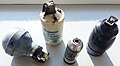 Tear gas shells used in Istanbul in 2013


