Dihydrofolic acid: Difference between revisions
CSV import |
CSV import |
||
| Line 21: | Line 21: | ||
{{biochemistry-stub}} | {{biochemistry-stub}} | ||
{{medicine-stub}} | {{medicine-stub}} | ||
== Dihydrofolic acid gallery == | |||
<gallery> | |||
File:Dihydrofolic acid.svg|Dihydrofolic acid structure | |||
File:Dihydrofolic-acid-3D-spacefill.png|Dihydrofolic acid 3D spacefill model | |||
</gallery> | |||
Latest revision as of 17:51, 3 March 2025
Dihydrofolic acid (also known as DHF) is a biochemical compound that plays a crucial role in the metabolism of cells. It is a derivative of folic acid, and is converted into tetrahydrofolic acid (THF) by the enzyme dihydrofolate reductase.
Structure and Properties[edit]
Dihydrofolic acid is a molecule composed of a pteridine ring, para-aminobenzoic acid (PABA), and glutamic acid. The pteridine ring and PABA are linked together to form the folic acid structure, while the glutamic acid is attached to the PABA portion of the molecule.
Biological Role[edit]
In the body, dihydrofolic acid is converted into tetrahydrofolic acid by the enzyme dihydrofolate reductase. This conversion is an important step in the synthesis of purines and pyrimidines, which are essential building blocks of DNA and RNA.
Clinical Significance[edit]
Dihydrofolic acid and its metabolic pathway have significant clinical implications. Many chemotherapeutic drugs, such as methotrexate, work by inhibiting the enzyme dihydrofolate reductase, thereby preventing the conversion of dihydrofolic acid to tetrahydrofolic acid. This inhibits DNA synthesis and cell division, which is particularly effective against rapidly dividing cancer cells.
See Also[edit]
.svg)
This article is a biochemistry stub. You can help WikiMD by expanding it!

Dihydrofolic acid gallery[edit]
-
 Dihydrofolic acid structure
 -
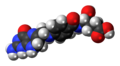 Dihydrofolic acid 3D spacefill model


