Kathmandu Valley: Difference between revisions
CSV import |
CSV import |
||
| Line 29: | Line 29: | ||
{{Asia-geo-stub}} | {{Asia-geo-stub}} | ||
{{food-stub}} | {{food-stub}} | ||
<gallery> | |||
File:Basantapurpalace.JPG|Basantapur Palace | |||
File:Pashupatinathskc.JPG|Pashupatinath Temple | |||
File:Syambhunath_Stupa.jpg|Swayambhunath Stupa | |||
File:Airport_and_himalaya.jpg|Airport and Himalaya | |||
File:Desay_madu_jhya.jpg|Desay Madu Jhya | |||
File:Kathmandu_Durbar_Square,_Maju_Dega_2,_Nepal.jpg|Kathmandu Durbar Square, Maju Dega | |||
File:Narayanhiti_Palace_Museum.jpg|Narayanhiti Palace Museum | |||
</gallery> | |||
Latest revision as of 11:13, 18 February 2025
Kathmandu Valley is a region in Nepal that encompasses the country's capital city, Kathmandu, and its surrounding areas. The valley is situated in the Bagmati Zone of Nepal and is a cultural and political hub of the country.
Geography[edit]
The Kathmandu Valley is located in the central part of Nepal and is surrounded by four major mountains: Shivapuri, Phulchoki, Nagarjun, and Chandragiri. The valley covers an area of about 220 square miles and is approximately 1,400 meters above sea level. The valley is drained by the Bagmati River and its tributaries.
History[edit]
The history of the Kathmandu Valley is rich and complex, with human habitation dating back to at least 300 BC. The valley was historically the seat of the Newar kingdom, a major civilization in the Himalayan region. The valley is home to seven UNESCO World Heritage Sites, which include the historic areas of Kathmandu, Patan, and Bhaktapur, as well as several important Buddhist and Hindu temples.
Culture[edit]
The Kathmandu Valley is known for its unique Newari culture, which is characterized by a distinct architectural style, traditional crafts, festivals, and a unique cuisine. The valley is also a major center for Nepal's music and dance traditions, and is home to several institutions dedicated to the preservation of Nepal's cultural heritage.
Economy[edit]
The economy of the Kathmandu Valley is diverse, with significant contributions from agriculture, trade, and tourism. The valley is Nepal's most important industrial and commercial center, and is home to a large number of businesses and industries. Tourism is a major economic driver, with visitors drawn to the valley's cultural heritage sites, outdoor activities, and unique local cuisine.
Cuisine[edit]
The cuisine of the Kathmandu Valley is a reflection of its cultural diversity. The traditional Newari cuisine is particularly notable, with dishes such as Bara, Yomari, and Chatamari. The valley is also known for its street food, which includes momos, sekuwa, and chatpate.
See also[edit]


-
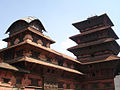 Basantapur Palace
 -
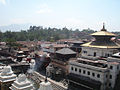 Pashupatinath Temple
 -
 Swayambhunath Stupa
 -
 Airport and Himalaya
 -
 Desay Madu Jhya
 -
 Kathmandu Durbar Square, Maju Dega
 -
 Narayanhiti Palace Museum


