Rhea (bird): Difference between revisions
CSV import |
CSV import |
||
| Line 31: | Line 31: | ||
{{Bird-stub}} | {{Bird-stub}} | ||
{{food-stub}} | {{food-stub}} | ||
== Rhea (bird) == | |||
<gallery> | |||
File:greater_rhea_pair_arp.jpg|Greater rhea pair | |||
File:Rhea_dustbathing_at_Marwell_zoo.JPG|Rhea dustbathing at Marwell zoo | |||
File:Nandu_Rhea_americana_Tierpark_Hellabrunn-1.jpg|Nandu Rhea americana Tierpark Hellabrunn | |||
File:Rhea_americana.svg|Rhea americana | |||
File:Rhea_pennata_pennata_(6).JPG|Rhea pennata pennata | |||
File:Distribution_of_Rhea_pennata.svg|Distribution of Rhea pennata | |||
File:Greater_rhea_close_up.jpg|Greater rhea close up | |||
File:Nandu,_Parque_Luro,_La_Pampa,_Argentina.jpg|Nandu, Parque Luro, La Pampa, Argentina | |||
</gallery> | |||
Latest revision as of 00:58, 27 February 2025
Rhea is a genus of flightless birds native to South America. The two extant species, the Greater Rhea (Rhea americana) and the Lesser Rhea (Rhea pennata), are known for their large size, long legs, and ability to run at high speeds.
Taxonomy[edit]
The genus Rhea was first described by Carl Linnaeus in his 18th-century work, Systema Naturae. The name "rhea" was used in Greek mythology for the mother of the gods, and is a nod to the bird's large size.
Description[edit]
Rheas are large, flightless birds with grey-brown plumage, long legs and long necks, similar to an ostrich. They can reach 1.50 metres (4.9 ft) to 1.70 metres (5.6 ft) tall and weigh up to 40 kilograms (88 lb). Their wings are large for a flightless bird and are spread while running, to act like sails. Unlike most birds, rheas have only three toes.
Distribution and habitat[edit]
Rheas are native to South America and are found in open and semi-open habitats, including grasslands, savanna, scrub forest, and even desert. They are endemic to Argentina, Bolivia, Brazil, Chile, Paraguay, Peru, and Uruguay.
Behaviour and ecology[edit]
Rheas are herbivores, preferring broad-leafed plants but also consuming seeds, roots, fruit, lizards, and insects. They are known for their mating ritual, where males incubate the eggs and raise the young.
Conservation[edit]
Both species of rhea are considered Near Threatened by the IUCN Red List. Their populations have been declining due to hunting, egg-collecting, and habitat loss.
Cultural significance[edit]
In South American culture, rheas are often featured in folklore and mythology. They are also economically important for their meat, eggs, and feathers.
See also[edit]


Rhea (bird)[edit]
-
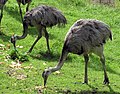 Greater rhea pair
 -
 Rhea dustbathing at Marwell zoo
 -
 Nandu Rhea americana Tierpark Hellabrunn
 -
 Rhea americana
 -
 Rhea pennata pennata
 -
 Distribution of Rhea pennata
 -
 Greater rhea close up
 -
 Nandu, Parque Luro, La Pampa, Argentina


.JPG)


