Neapolitan pizza: Difference between revisions
CSV import |
CSV import Tags: mobile edit mobile web edit |
||
| Line 25: | Line 25: | ||
{{Pizza}} | {{Pizza}} | ||
{{food-stub}} | {{food-stub}} | ||
<gallery> | |||
File:Neapolitan_pizza_at_Trappica_(48701940197).jpg|Neapolitan pizza at Trappica | |||
File:Punch_Neapolitan_Pizza_Margherita.jpg|Punch Neapolitan Pizza Margherita | |||
</gallery> | |||
Latest revision as of 01:34, 18 February 2025
Neapolitan pizza is a style of pizza that originated in Naples, Italy. This style of pizza is characterized by a raised, soft and chewy crust, a bright, tangy tomato sauce, fresh mozzarella cheese, and fresh basil. The ingredients used in Neapolitan pizza are strictly regulated by the Associazione Verace Pizza Napoletana (True Neapolitan Pizza Association), which sets the standards for authentic Neapolitan pizza.
History[edit]
The history of Neapolitan pizza dates back to the late 18th century in Naples, a city in southern Italy. The pizza was originally a food for the poor, made with simple and inexpensive ingredients. The classic Margherita pizza, topped with tomatoes, mozzarella cheese, and basil, was reportedly created in 1889 by a local pizzaiolo in honor of Queen Margherita of Italy.
Ingredients[edit]
The ingredients used in Neapolitan pizza are specific and regulated by the Associazione Verace Pizza Napoletana. The dough is made from a type of wheat flour called "00", water, sea salt, and yeast. The sauce is made from San Marzano tomatoes, a type of plum tomato grown in the volcanic soil of Mount Vesuvius. The cheese used is fresh mozzarella, either fior di latte made from cow's milk, or mozzarella di bufala, made from the milk of water buffalo. The pizza is typically topped with fresh basil and extra-virgin olive oil.
Preparation and Cooking[edit]
The dough for Neapolitan pizza is hand-kneaded and must not be rolled with a rolling pin. It is then left to rise for a period of time. The pizza is baked in a wood-fired, dome-shaped oven at a high temperature for a short period of time. This results in a pizza that is soft, elastic, and easily foldable. The crust is puffy and slightly charred, and the center is thin and soft.
Recognition[edit]
In 2009, Neapolitan pizza was granted Traditional Speciality Guaranteed (TSG) status by the European Union. This designation recognizes the traditional methods and ingredients used in the preparation of Neapolitan pizza, and protects its name against imitation and misuse.
See Also[edit]
| Italian cuisine |
|---|
|
|
| Pizza |
|---|
|
[[File:File:Pizza slice icon.png|200px|center|alt=]]
|

-
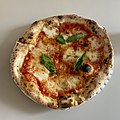 Neapolitan pizza at Trappica
 -
 Punch Neapolitan Pizza Margherita
.jpg)


