Pinus koraiensis: Difference between revisions
CSV import |
CSV import |
||
| Line 27: | Line 27: | ||
{{trees-stub}} | {{trees-stub}} | ||
{{food-stub}} | {{food-stub}} | ||
== Pinus koraiensis == | |||
<gallery> | |||
File:Pinus_koraiensis.jpg|Pinus koraiensis | |||
File:Pinus_koraiensis,_Mount_Auburn_Cemetery.JPG|Pinus koraiensis | |||
File:Pinus_koraiensis_(Korean_Pine)_-_Flickr_-_S._Rae.jpg|Pinus koraiensis | |||
File:Immature_Korean_pine_cone._From_a_cultivated_Korean_pine_forest..png|Pinus koraiensis | |||
File:Korean_pine_seedlings.jpg|Pinus koraiensis | |||
File:잣.jpg|Pinus koraiensis | |||
File:Jat_(pine_nut)_(Pinus_koraiensis).jpg|Pinus koraiensis | |||
File:Pinus_koraiensis_Pinus_parviflora_SZ116.png|Pinus koraiensis | |||
File:Korean_Pine_Trees_in_Seoul.jpg|Pinus koraiensis | |||
File:Korean_pine_(Pinus_koraiensis)_trees_crowns.jpg|Pinus koraiensis | |||
File:Korean_pine_(Pinus_koraiensis)_trunk_cross_section.jpg|Pinus koraiensis | |||
File:Young_Korean_pine_(Pinus_koraiensis).jpg|Pinus koraiensis | |||
</gallery> | |||
Revision as of 12:07, 18 February 2025
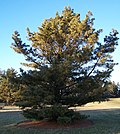
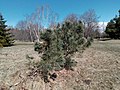
Pinus koraiensis, also known as the Korean pine, is a species of pine tree native to eastern Asia. It is a member of the family Pinaceae, and is one of the most important tree species in the region due to its economic and ecological value.
Description
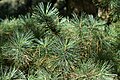
The Pinus koraiensis is a large evergreen tree that can grow up to 30 meters in height. The bark is grey and scaly, and the leaves, or needles, are dark green and grow in bundles of five. The cones are large and cylindrical, containing numerous winged seeds.
Distribution and habitat
The Pinus koraiensis is native to eastern Asia, including parts of Korea, China, Japan, and Russia. It is typically found in cool, mountainous regions, and is well-adapted to cold climates.
Uses
The seeds of the Pinus koraiensis, known as Korean pine nuts, are a valuable food source in many parts of Asia. They are used in a variety of dishes, including salads, desserts, and sauces. The wood of the tree is also used for construction and furniture making.
Conservation
While the Pinus koraiensis is not currently considered endangered, it is under threat from deforestation and habitat loss. Efforts are being made to conserve the species and its habitat, including the establishment of protected areas and sustainable forestry practices.
See also
This tree-related article is a stub. You can help WikiMD by expanding it.

Pinus koraiensis
-
 Pinus koraiensis
 -
 Pinus koraiensis
 -
 Pinus koraiensis
 -
 Pinus koraiensis
 -
 Pinus koraiensis
 -
 Pinus koraiensis
 -
 Pinus koraiensis
 -
 Pinus koraiensis
 -
 Pinus koraiensis
 -
 Pinus koraiensis
 -
 Pinus koraiensis
 -
 Pinus koraiensis


_-_Flickr_-_S._Rae.jpg)


_(Pinus_koraiensis).jpg)


_trees_crowns.jpg)
_trunk_cross_section.jpg)
.jpg)
