Nabemono: Difference between revisions
CSV import Tags: mobile edit mobile web edit |
CSV import |
||
| Line 33: | Line 33: | ||
{{Japanese-cuisine-stub}} | {{Japanese-cuisine-stub}} | ||
{{food-stub}} | {{food-stub}} | ||
<gallery> | |||
File:Cookingsukiyaki.jpg|Nabemono | |||
File:Udonsuki by yajico in Tokyo.jpg|Nabemono | |||
File:Chankonabe.jpg|Nabemono | |||
File:Yudōfu 001.jpg|Nabemono | |||
File:Sukiyaki 01.jpg|Nabemono | |||
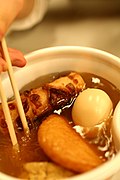
File:Oden by Mori Chan.jpg|Nabemono | |||
File:Motsunabe.jpg|Nabemono | |||
File:Nabe being made at a dinner party in Japan.jpg|Nabemono | |||
File:Harihari-nabe.jpg|Nabemono | |||
</gallery> | |||
Latest revision as of 00:59, 20 February 2025
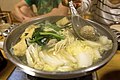
Nabemono (often shortened to nabe) is a variety of Japanese cuisine that is often referred to as a "hot pot" dish. The term "nabemono" is derived from the Japanese words "nabe" (cooking pot) and "mono" (things), indicating the nature of the dish as a pot filled with various ingredients.
History[edit]
The origins of nabemono can be traced back to the Jomon period in Japan, where earthenware pots were used for cooking. The dish evolved over time, with different regions in Japan developing their own unique styles and ingredients.
Preparation and Serving[edit]
Nabemono is typically prepared in a large pot, often in the center of the dining table over a portable stove. The dish is cooked at the table, and diners can select from the pot what they wish to eat. Ingredients can vary widely, but often include items such as tofu, noodles, seafood, and vegetables. The ingredients are simmered in a variety of broths, which can be soy-based, miso-based, or made from other ingredients.
Varieties[edit]
There are many different types of nabemono, including:
- Sukiyaki: This version of nabemono includes thinly sliced beef, tofu, and vegetables, cooked in a sweet soy sauce broth.
- Shabu-shabu: In this variety, very thin slices of meat are briefly cooked in the broth, then dipped in a sesame or ponzu sauce before eating.
- Chankonabe: This is a hearty version of nabemono often eaten by sumo wrestlers. It typically includes a variety of protein sources, including chicken, fish, and tofu.
Cultural Significance[edit]
Nabemono is often associated with the colder months in Japan, as the hot pot provides a warming meal. It is also a popular choice for communal meals, as the shared pot encourages a sense of togetherness and camaraderie.
See Also[edit]

This Japanese cuisine related article is a stub. You can help WikiMD by expanding it.

-
 Nabemono
 -
 Nabemono
 -
 Nabemono
 -
 Nabemono
 -
 Nabemono
 -
 Nabemono
 -
 Nabemono
 -
Nabemono
-
Nabemono


