Grain trade: Difference between revisions
CSV import Tags: mobile edit mobile web edit |
CSV import |
||
| Line 30: | Line 30: | ||
[[Category:Grains]] | [[Category:Grains]] | ||
{{food-stub}} | {{food-stub}} | ||
<gallery> | |||
File:Grenier-égyptien-maspero.png|Grenier égyptien maspero | |||
File:Ancientgrain.png|Ancient grain | |||
File:The_American_elevator_and_grain_trade_(IA_CAT31053470136).pdf|The American elevator and grain trade | |||
File:Tab,_Indiana_-_Railroad.png|Tab, Indiana - Railroad | |||
File:1893_grain_market_Teheran_HarpersMagazine_v87_no522.png|1893 grain market Teheran Harpers Magazine | |||
File:Minneapolis-Grain-Exchange-1939-bidding.jpg|Minneapolis Grain Exchange 1939 bidding | |||
File:Concrete-Central_Elevator_of_Buffalo,_New_York_with_a_4,500,000_bushel_capacity_built_by_Monarch_Engineering_Company_-_from_the_January_1919_periodical,_The_American_Elevator_and_Grain_Trade_(IA_CAT31053470311)_(page_12_crop).jpg|Concrete-Central Elevator of Buffalo, New York | |||
File:Bulk_carrier_arriving_in_port.jpg|Bulk carrier arriving in port | |||
</gallery> | |||
Latest revision as of 11:35, 25 February 2025
Grain Trade
The Grain Trade refers to the local and international trading of grains such as wheat, corn, barley, and rice. This trade is a crucial part of the global agriculture industry and plays a significant role in the economies of many countries.
History[edit]
The history of the grain trade can be traced back to ancient civilizations. The Ancient Egyptians were known to trade grains along the Nile River, while the Ancient Romans established sophisticated grain trade networks across the Mediterranean Sea. The grain trade continued to evolve throughout the Middle Ages and into the Industrial Revolution, with the development of new technologies and transportation methods greatly increasing the scale and efficiency of grain trading.
Modern Grain Trade[edit]
Today, the grain trade is a highly complex and globalized industry. Major grain exporting countries include the United States, Canada, Australia, and Russia, while major importers include China, Japan, and the European Union. The grain trade is heavily influenced by factors such as weather conditions, crop yields, political policies, and global market trends.
Grain Trade Organizations[edit]
There are numerous organizations involved in the grain trade, ranging from local cooperatives to international bodies. These include the International Grains Council, which oversees the international trade of grains, and the National Grain and Feed Association in the United States, which represents the interests of grain traders and processors.
Challenges and Controversies[edit]
The grain trade has faced various challenges and controversies. These include issues related to food security, sustainability, and the impact of climate change on crop yields. There have also been concerns about the concentration of market power in the hands of a few large multinational corporations, known as the "ABCD" companies (ADM, Bunge, Cargill, and Dreyfus).
See Also[edit]

-
 Grenier égyptien maspero
 -
 Ancient grain
 -
 The American elevator and grain trade
 -
 Tab, Indiana - Railroad
 -
 1893 grain market Teheran Harpers Magazine
 -
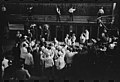 Minneapolis Grain Exchange 1939 bidding
 -
 Concrete-Central Elevator of Buffalo, New York
 -
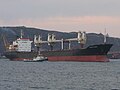 Bulk carrier arriving in port


_(page_12_crop).jpg)

