Cheese dog: Difference between revisions
CSV import Tags: mobile edit mobile web edit |
CSV import |
||
| Line 18: | Line 18: | ||
[[Category:Fast food]] | [[Category:Fast food]] | ||
{{food-stub}} | {{food-stub}} | ||
<gallery> | |||
File:Selection_of_hot_dogs.jpg|A variety of hot dogs with different toppings. | |||
File:Brunost.jpg|A block of Norwegian brown cheese known as Brunost. | |||
File:Hotdogs.JPG|Hot dogs being grilled on a barbecue. | |||
File:Njbrkfast.jpg|A typical New Jersey breakfast with eggs and bacon. | |||
</gallery> | |||
Latest revision as of 04:55, 18 February 2025
Cheese dog is a type of hot dog that is typically topped with cheese or, in some cases, filled with cheese. The cheese used can vary, but common choices include cheddar, American cheese, and cheese sauce. Cheese dogs are popular in many parts of the world, including the United States, Canada, and Australia.
History[edit]
The exact origins of the cheese dog are unclear, but it likely evolved from the traditional hot dog, which has been a staple of American cuisine since the late 19th century. The addition of cheese to the hot dog likely occurred in the mid-20th century, as processed cheese products became more widely available.
Preparation[edit]
To prepare a cheese dog, a hot dog is typically grilled or boiled, then placed in a hot dog bun. Cheese is then added on top of the hot dog. In some cases, the cheese may be melted onto the hot dog using a broiler or microwave. Some variations of the cheese dog involve injecting the hot dog with cheese before cooking.
Variations[edit]
There are many variations of the cheese dog. For example, the chili cheese dog includes chili along with the cheese. The Coney Island hot dog, popular in the Midwest United States, is a type of cheese dog that also includes onions and mustard. In Australia, a popular variation is the dagwood dog, which is a deep-fried, cheese-filled hot dog.
See also[edit]

-
 A variety of hot dogs with different toppings.
 -
 A block of Norwegian brown cheese known as Brunost.
 -
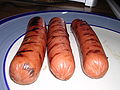 Hot dogs being grilled on a barbecue.
 -
 A typical New Jersey breakfast with eggs and bacon.


