Chebureki: Difference between revisions
CSV import |
CSV import |
||
| Line 25: | Line 25: | ||
[[Category:Deep fried foods]] | [[Category:Deep fried foods]] | ||
{{food-stub}} | {{food-stub}} | ||
<gallery> | |||
File:Ayran+Çibörek.jpg|Ayran served with Çibörek | |||
File:Example_of_serving_Çi__Börek.jpg|Example of serving Çi_ Börek | |||
File:Burek2.jpg|Chebureki | |||
</gallery> | |||
Revision as of 01:17, 18 February 2025
Chebureki, also known as chiburekki, is a deep-fried turnover with a filling of ground or minced meat and onions. It is a popular street food and comfort food in many post-Soviet states, Turkey, and the Balkans.
Origin and Etymology
The word Chebureki is derived from the Crimean Tatar word çiberek, which means "raw". The dish is believed to have originated from the Crimean Tatars, but it has been widely adopted and is now considered a part of the national cuisines of many countries in Eastern Europe and Central Asia.
Preparation
The dough for Chebureki is made from flour, water, and sometimes egg. The filling typically consists of ground or minced meat (usually lamb or beef), onions, and spices. The dough is rolled out into circles, filled with the meat mixture, folded over to form a half-moon shape, and then deep-fried until golden brown.
Variations
There are many regional variations of Chebureki. In Russia, they are often served with sour cream or tomato sauce. In Turkey, they are known as çiğ börek and are typically filled with ground beef and cheese. In the Balkans, they are often filled with cheese, spinach, or potatoes and are known as burek.
Cultural Significance
Chebureki is a popular street food in many countries. It is often associated with comfort food and is commonly consumed as a quick snack or meal. In some cultures, it is also a traditional dish served during special occasions or festivals.
See Also

-
 Ayran served with Çibörek
 -
Example of serving Çi_ Börek
-
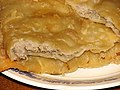 Chebureki


