Jjigae: Difference between revisions
CSV import |
CSV import |
||
| Line 26: | Line 26: | ||
{{Korea-food-stub}} | {{Korea-food-stub}} | ||
{{food-stub}} | {{food-stub}} | ||
== Jjigae == | |||
<gallery> | |||
File:Korean.cuisine-Dubu.jjigae-01.jpg|Dubu Jjigae | |||
File:Korean_stew-Sundubu_jjigae-05.jpg|Sundubu Jjigae | |||
File:0812_dongtaejjigae.jpg|Dongtae Jjigae | |||
File:Dubu_jjigae,_at_Washoku-Sato_(2014.04.19).jpg|Dubu Jjigae at Washoku-Sato | |||
</gallery> | |||
Latest revision as of 04:22, 18 February 2025
Jjigae is a term used in Korean cuisine to describe a variety of stew-like dishes. The word "jjigae" is often translated as "stew", but the dishes it refers to can vary widely in terms of ingredients, preparation methods, and cultural significance.
Etymology[edit]
The term "jjigae" comes from the Korean language, and is derived from the verb "jjigae-da", which means "to stew" or "to boil". It is often used to refer to dishes that are simmered or boiled for a long time, and can include a wide variety of ingredients.
Types of Jjigae[edit]
There are many different types of jjigae, each with its own unique set of ingredients and preparation methods. Some of the most popular types include:
- Kimchi jjigae: This is a spicy stew made with kimchi, a traditional Korean fermented vegetable dish. It often includes other ingredients such as tofu, pork, and onions.
- Doenjang jjigae: This is a stew made with doenjang, a type of fermented soybean paste. It often includes vegetables, seafood, or meat.
- Sundubu jjigae: This is a spicy stew made with soft tofu, seafood, and vegetables. It is often served in a hot stone pot.
Cultural Significance[edit]
Jjigae is a staple dish in Korean cuisine, and is often served as part of a meal along with rice and banchan, or side dishes. It is often eaten with a spoon, and is typically served hot, often still bubbling from the heat of cooking.
See Also[edit]

Jjigae[edit]
-
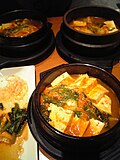 Dubu Jjigae
 -
 Sundubu Jjigae
 -
 Dongtae Jjigae
 -
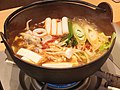 Dubu Jjigae at Washoku-Sato


.jpg)
