Grooved carpet shell: Difference between revisions
CSV import |
CSV import |
||
| Line 26: | Line 26: | ||
{{Bivalve-stub}} | {{Bivalve-stub}} | ||
{{food-stub}} | {{food-stub}} | ||
<gallery> | |||
File:Ruditapes_decussatus_03.jpg|Grooved carpet shell | |||
File:Ruditapes_decussatus_04.jpg|Grooved carpet shell | |||
File:Ruditapes_decussatus_01.jpg|Grooved carpet shell | |||
File:Ruditapes_decussatus_02.jpg|Grooved carpet shell | |||
</gallery> | |||
Latest revision as of 04:53, 18 February 2025
Grooved Carpet Shell (Ruditapes decussatus) is a species of clam in the family Veneridae, the venus clams. It is a marine bivalve mollusc that is extensively harvested for food and is a significant part of the aquaculture industry in several countries.
Description[edit]
The Grooved Carpet Shell is a medium-sized clam, typically reaching a length of 5 to 10 cm. The shell is broadly oval in shape, with a slightly pointed umbo. The exterior of the shell is sculpted with numerous fine concentric lines and radial ribs, giving it a cross-hatched appearance. The color of the shell is usually white or cream, often with brown or yellowish patches.
Distribution and Habitat[edit]
The Grooved Carpet Shell is native to the eastern Atlantic Ocean, from Norway to Morocco, and is also found in the Mediterranean Sea. It inhabits sandy or muddy bottoms, from the lower intertidal zone to depths of up to 40 meters.
Life Cycle and Behavior[edit]
Grooved Carpet Shells are filter feeders, extracting plankton and other small particles from the water. They have a complex life cycle, with a planktonic larval stage that lasts several weeks before the larvae settle and metamorphose into juvenile clams.
Economic Importance[edit]
The Grooved Carpet Shell is one of the most economically important species of clam in Europe. It is harvested both by commercial fisheries and by recreational clammers. The species is also cultivated in aquaculture, particularly in Spain, Portugal, and France.
Conservation[edit]
While the Grooved Carpet Shell is not currently considered threatened, it is vulnerable to overfishing, habitat loss, and pollution. Management measures, including size limits and closed seasons, are in place in many areas to ensure sustainable harvests.
See Also[edit]


-
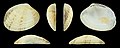 Grooved carpet shell
 -
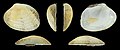 Grooved carpet shell
 -
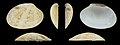 Grooved carpet shell
 -
 Grooved carpet shell


