Mapuche: Difference between revisions
CSV import |
CSV import |
||
| Line 39: | Line 39: | ||
[[Category:Ethnic groups in Argentina]] | [[Category:Ethnic groups in Argentina]] | ||
{{stub}} | {{stub}} | ||
<gallery> | |||
File:Mujeres mapuches en la entrega terreno a Comunidad Mapuche Lorenzo Quintrileo de Tirúa.jpg|Mujeres mapuches en la entrega terreno a Comunidad Mapuche Lorenzo Quintrileo de Tirúa | |||
File:Mapuche macro-ethnicity.png|Mapuche macro-ethnicity | |||
File:MapvsInc.JPG|Map vs Inc | |||
File:Pueblos indigenas de Chile.svg|Pueblos indígenas de Chile | |||
File:El joven Lautaro - P. Subercaseaux.PNG|El joven Lautaro - P. Subercaseaux | |||
File:Grabado Caupolican-Nicanor Plaza.jpg|Grabado Caupolican-Nicanor Plaza | |||
File:Ocupacion de la Araucanía 1869.JPG|Ocupación de la Araucanía 1869 | |||
File:Lautaro flag.svg|Lautaro flag | |||
File:Mapuche telas y juegos.jpg|Mapuche telas y juegos | |||
File:A council of araucanian philosophers (1904).jpg|A council of araucanian philosophers (1904) | |||
</gallery> | |||
Latest revision as of 04:58, 3 March 2025
Mapuche
The Mapuche are a group of indigenous inhabitants of south-central Chile and southwestern Argentina, including parts of present-day Patagonia. The collective term refers to a wide-ranging ethnicity composed of various groups who shared a common social, religious, and economic structure, as well as a common linguistic heritage as Mapudungun speakers. Their influence once extended from the Aconcagua River to the Chiloé Archipelago and spread later eastward to the Argentine pampa. Today the collective group makes up over 80% of the indigenous peoples in Chile, and about 9% of the total Chilean population. They are particularly concentrated in Araucanía. Many have migrated to Santiago for economic opportunities.
History[edit]
The Mapuche are known for their long history of resistance against the Spanish and later the independent Chilean and Argentine states. In the Arauco War, the Mapuche fought against Spanish conquerors, a conflict that lasted for over three centuries. The Mapuche also fought in the Argentine Civil Wars. In the late 19th century, the Chilean and Argentine states launched campaigns, the Occupation of Araucanía and Conquest of the Desert, to subdue Mapuche territories. These campaigns dramatically reduced the Mapuche population and territory.
Culture[edit]
Mapuche culture is rich and varied. It includes a strong tradition of weaving and pottery, as well as music, poetry, and storytelling. The Mapuche's relationship with the land and nature also plays a crucial role in their culture, and is often reflected in their belief systems and rituals.
Language[edit]
The Mapuche language, Mapudungun, is a language isolate. It is still spoken by a significant number of Mapuche people, particularly in rural communities. However, the language is at risk of extinction, with a decline in the number of speakers in recent years.
Religion[edit]
The Mapuche traditional religion is polytheistic. It is deeply interwoven with their culture and daily life. The Mapuche believe in a variety of gods and spirits, and they perform a number of rituals and ceremonies to honor them.
See also[edit]
- Araucanía Region
- Arauco War
- Chile
- Argentina
- Indigenous peoples in Chile
- Indigenous peoples in Argentina
References[edit]
<references />
External links[edit]
 | |
|---|---|
 |
 |
-
 Mujeres mapuches en la entrega terreno a Comunidad Mapuche Lorenzo Quintrileo de Tirúa
 -
 Mapuche macro-ethnicity
 -
 Map vs Inc
 -
 Pueblos indígenas de Chile
 -
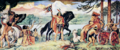 El joven Lautaro - P. Subercaseaux
 -
 Grabado Caupolican-Nicanor Plaza
 -
 Ocupación de la Araucanía 1869
 -
 Lautaro flag
 -
 Mapuche telas y juegos
 -
 A council of araucanian philosophers (1904)


.jpg)
