Typography: Difference between revisions
CSV import |
CSV import |
||
| Line 1: | Line 1: | ||
{{short description|The art and technique of arranging type to make written language legible, readable, and appealing}} | |||
{{Use dmy dates|date=October 2023}} | |||
Typography is | '''Typography''' is the art and technique of arranging [[type]] to make written language legible, readable, and appealing when displayed. The arrangement of type involves selecting [[typefaces]], point sizes, line lengths, line-spacing (leading), and letter-spacing (tracking), and adjusting the space between pairs of letters (kerning). The term typography is also applied to the style, arrangement, and appearance of the letters, numbers, and symbols created by the process. | ||
==History== | ==History== | ||
The history of typography | The history of typography dates back to the first punches and dies used to make seals and currency in ancient times. The first known movable type system was created in China by [[Bi Sheng]] around 1040 AD, using ceramic materials. The oldest known book printed with movable metal type is the ''[[Jikji]]'', printed in Korea in 1377. | ||
In Europe, the invention of the [[printing press]] by [[Johannes Gutenberg]] in the 15th century revolutionized the production of books and the dissemination of knowledge. Gutenberg's press used movable type made of metal, which allowed for the mass production of texts. | |||
===Development in Europe=== | |||
The development of typography in Europe was marked by the creation of new typefaces and the refinement of printing techniques. The [[Renaissance]] period saw the emergence of typefaces such as [[Garamond]] and [[Baskerville]], which are still in use today. | |||
== | ===Modern Typography=== | ||
In the 20th century, typography evolved with the advent of digital typesetting and desktop publishing. The development of software like [[Adobe Illustrator]] and [[LaTeX]] has allowed for more precise control over typographic elements. | |||
* | ==Techniques== | ||
Typography involves several techniques to ensure that text is both legible and aesthetically pleasing. These include: | |||
* '''Typefaces''': The design of the characters, which can be serif or sans-serif. | |||
* '''Point size''': The size of the type, measured in points. | |||
* '''Line length''': The width of a block of text. | |||
* '''Leading''': The vertical space between lines of text. | |||
* '''Kerning''': The adjustment of space between individual letter pairs. | |||
* '''Tracking''': The uniform adjustment of space between all letters in a block of text. | |||
==Related pages== | |||
* [[Printing press]] | * [[Printing press]] | ||
* [[Movable type]] | * [[Movable type]] | ||
* [[Typeface]] | |||
* [[Calligraphy]] | |||
==References== | ==References== | ||
< | * Bringhurst, Robert. ''The Elements of Typographic Style''. Hartley & Marks, 1992. | ||
* Meggs, Philip B. ''A History of Graphic Design''. John Wiley & Sons, 1998. | |||
==Gallery== | |||
<gallery> | |||
File:Trajan typeface specimen.svg|Specimen of the Trajan typeface | |||
File:Metal movable type.jpg|Metal movable type | |||
File:Chinese movable type 1313-ce.png|Chinese movable type | |||
File:JikjiType.gif|Type from the ''Jikji'' | |||
File:Pressing-16th century.jpg|16th-century printing press | |||
File:A Specimen by William Caslon.jpg|Specimen by William Caslon | |||
File:Oscar wilde english renaissance of art 2.png|Oscar Wilde's ''The English Renaissance of Art'' | |||
File:Latex example type.svg|Example of LaTeX typesetting | |||
File:John Wilkes Booth wanted poster new.jpg|Wanted poster for John Wilkes Booth | |||
File:Rydal Mount Plaque - geograph.org.uk - 895220.jpg|Plaque at Rydal Mount | |||
</gallery> | |||
[[Category:Typography]] | [[Category:Typography]] | ||
Revision as of 00:40, 10 February 2025
The art and technique of arranging type to make written language legible, readable, and appealing
Typography is the art and technique of arranging type to make written language legible, readable, and appealing when displayed. The arrangement of type involves selecting typefaces, point sizes, line lengths, line-spacing (leading), and letter-spacing (tracking), and adjusting the space between pairs of letters (kerning). The term typography is also applied to the style, arrangement, and appearance of the letters, numbers, and symbols created by the process.
History
The history of typography dates back to the first punches and dies used to make seals and currency in ancient times. The first known movable type system was created in China by Bi Sheng around 1040 AD, using ceramic materials. The oldest known book printed with movable metal type is the Jikji, printed in Korea in 1377.
In Europe, the invention of the printing press by Johannes Gutenberg in the 15th century revolutionized the production of books and the dissemination of knowledge. Gutenberg's press used movable type made of metal, which allowed for the mass production of texts.
Development in Europe
The development of typography in Europe was marked by the creation of new typefaces and the refinement of printing techniques. The Renaissance period saw the emergence of typefaces such as Garamond and Baskerville, which are still in use today.
Modern Typography
In the 20th century, typography evolved with the advent of digital typesetting and desktop publishing. The development of software like Adobe Illustrator and LaTeX has allowed for more precise control over typographic elements.
Techniques
Typography involves several techniques to ensure that text is both legible and aesthetically pleasing. These include:
- Typefaces: The design of the characters, which can be serif or sans-serif.
- Point size: The size of the type, measured in points.
- Line length: The width of a block of text.
- Leading: The vertical space between lines of text.
- Kerning: The adjustment of space between individual letter pairs.
- Tracking: The uniform adjustment of space between all letters in a block of text.
Related pages
References
- Bringhurst, Robert. The Elements of Typographic Style. Hartley & Marks, 1992.
- Meggs, Philip B. A History of Graphic Design. John Wiley & Sons, 1998.
Gallery
-
 Specimen of the Trajan typeface
 -
 Metal movable type
 -
 Chinese movable type
 -
Type from the Jikji
-
 16th-century printing press
 -
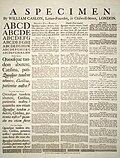 Specimen by William Caslon
 -
 Oscar Wilde's The English Renaissance of Art
 -
Example of LaTeX typesetting
-
Wanted poster for John Wilkes Booth
-
Plaque at Rydal Mount


