Ovarian serous cystadenoma: Difference between revisions
CSV import |
CSV import |
||
| Line 20: | Line 20: | ||
{{stub}} | {{stub}} | ||
<gallery> | |||
File:Ovarian_serous_cystadenoma_-_alt_--_low_mag.jpg|Ovarian serous cystadenoma - low magnification | |||
File:Ovarian_serous_cystadenoma_-_alt_--_low_mag.jpg|Ovarian serous cystadenoma - low magnification | |||
File:Ovarian_serous_cystadenoma_--_intermed_mag.jpg|Ovarian serous cystadenoma - intermediate magnification | |||
File:Ovarian_serous_cystadenoma_-_alt_--_intermed_mag.jpg|Ovarian serous cystadenoma - intermediate magnification | |||
File:Ovarian_serous_cystadenoma_-_alt_--_high_mag.jpg|Ovarian serous cystadenoma - high magnification | |||
File:Ovarian_serous_cystadenoma_--_high_mag.jpg|Ovarian serous cystadenoma - high magnification | |||
File:Ovarian_serous_cystadenoma_--_very_high_mag.jpg|Ovarian serous cystadenoma - very high magnification | |||
File:Ovarian_serous_cystadenoma_--_extremely_high_mag.jpg|Ovarian serous cystadenoma - extremely high magnification | |||
</gallery> | |||
Latest revision as of 12:22, 18 February 2025
Ovarian serous cystadenoma is a type of benign tumor that originates from the ovary. It is the most common type of ovarian tumor, accounting for approximately 20% of all ovarian tumors. The term "serous" refers to the thin, watery fluid that the tumor produces, and "cystadenoma" refers to the cystic nature of the tumor.
Symptoms[edit]
Most ovarian serous cystadenomas are asymptomatic and are discovered incidentally during routine gynecological examination. However, if the tumor becomes large, it may cause abdominal discomfort, bloating, or pain. In rare cases, the tumor may rupture, leading to severe abdominal pain and possible complications.
Diagnosis[edit]
The diagnosis of ovarian serous cystadenoma is typically made through ultrasound imaging, which can reveal the presence of a cystic mass in the ovary. Further diagnostic tests, such as CT scan or MRI, may be performed to better characterize the tumor and rule out other conditions. In some cases, a sample of the fluid within the tumor may be taken for analysis, a procedure known as cyst aspiration.
Treatment[edit]
The treatment for ovarian serous cystadenoma typically involves surgical removal of the tumor. This can often be performed laparoscopically, a minimally invasive procedure that involves small incisions in the abdomen. In some cases, the entire ovary may need to be removed, a procedure known as oophorectomy. Following surgery, most patients have an excellent prognosis, as these tumors are benign and do not spread to other parts of the body.
See also[edit]
 | |
|---|---|
 |
 |
-
 Ovarian serous cystadenoma - low magnification
 -
Ovarian serous cystadenoma - low magnification
-
 Ovarian serous cystadenoma - intermediate magnification
 -
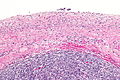 Ovarian serous cystadenoma - intermediate magnification
 -
 Ovarian serous cystadenoma - high magnification
 -
 Ovarian serous cystadenoma - high magnification
 -
 Ovarian serous cystadenoma - very high magnification
 -
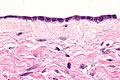 Ovarian serous cystadenoma - extremely high magnification


