Striatum: Difference between revisions
CSV import Tags: mobile edit mobile web edit |
CSV import |
||
| Line 41: | Line 41: | ||
{{stub}} | {{stub}} | ||
{{dictionary-stub1}} | {{dictionary-stub1}} | ||
<gallery> | |||
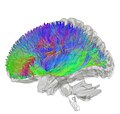
File:Cortical_surface_with_an_overlay_of_the_basal_ganglia_and_thalamus.jpg|Striatum | |||
File:Corticostriatal_Pathway.jpg|Striatum | |||
File:Striatum_Structural_MRI.png|Striatum | |||
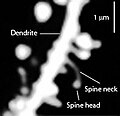
File:Dendritic_spines.jpg|Striatum | |||
File:Basalganglien.png|Striatum | |||
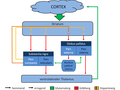
File:Basal_ganglia_circuits.svg|Striatum | |||
File:Overview_of_reward_structures_in_the_human_brain.jpg|Striatum | |||
File:Striatum_coronal_sections.gif|Striatum | |||
File:Striatum_sagittal_sections.gif|Striatum | |||
File:Striatum_transversal_sections.gif|Striatum | |||
</gallery> | |||
Revision as of 12:10, 18 February 2025
Striatum
The Striatum, or the striate nucleus, is a subcortical part of the forebrain. It receives glutamatergic and dopaminergic inputs from different sources and sends output to other components of the basal ganglia. The striatum plays a critical role in the control of movement and reward learning.
Structure
The striatum is divided into a ventral and a dorsal subdivision, based upon function and connections. The ventral striatum consists of the nucleus accumbens and the olfactory tubercle. The dorsal striatum consists of the caudate nucleus and the putamen.
Dorsal striatum
The dorsal striatum is composed of the caudate nucleus and the putamen. It is associated with motor and action planning, skill learning, and habit formation.
Ventral striatum
The ventral striatum is composed of the nucleus accumbens and the olfactory tubercle. It is associated with reward, pleasure, and addiction.
Function
The striatum coordinates multiple aspects of cognition, including motor and action planning, decision-making, motivation, reinforcement, and reward perception. It is also involved in the perception of time and the recognition of social cues.
Clinical significance
Dysfunction of the striatum may be associated with a number of disorders, including Parkinson's disease, Huntington's disease, and Tourette syndrome. It is also implicated in schizophrenia and bipolar disorder.
See also
References
<references />
 | |
|---|---|
 |
 |
| This medical article is a stub. You can help Wikipedia by adding missing information. |
-
 Striatum
 -
 Striatum
 -
 Striatum
 -
 Striatum
 -
 Striatum
 -
 Striatum
 -
 Striatum
 -
 Striatum
 -
 Striatum
 -
 Striatum


