Straight sinus: Difference between revisions
CSV import |
CSV import |
||
| Line 30: | Line 30: | ||
{{Anatomy-stub}} | {{Anatomy-stub}} | ||
<gallery> | |||
File:Gray488_blue.gif|Straight sinus - anatomical illustration | |||
File:Gray567.png|Straight sinus - sagittal section | |||
File:Gray569.png|Straight sinus - transverse section | |||
File:Straight_sinus.jpg|Straight sinus - MRI scan | |||
</gallery> | |||
Latest revision as of 04:33, 18 February 2025
Straight sinus
The straight sinus (Latin: sinus rectus) is an area of the dura mater, the outermost layer of the meninges, the membranes surrounding the brain and spinal cord. It is a dural venous sinus, a channel that carries blood from the brain back to the heart.
Anatomy[edit]
The straight sinus is located at the junction of the falx cerebri, a sickle-shaped fold of the dura mater that separates the two cerebral hemispheres, and the tentorium cerebelli, a horizontal fold of the dura mater that separates the cerebrum from the cerebellum. It runs in a posterior direction from the confluence of sinuses to the transverse sinuses.
Function[edit]
The straight sinus receives blood from the inferior sagittal sinus, which runs along the inferior edge of the falx cerebri, and the great cerebral vein, which drains blood from the inner areas of the brain. It then drains into the left transverse sinus.
Clinical significance[edit]
Due to its location, the straight sinus is relatively protected from injury. However, it can be involved in certain medical conditions. Thrombosis, or blood clot formation, in the straight sinus can lead to cerebral venous sinus thrombosis, a type of stroke. This is a rare condition, but can be life-threatening.
See also[edit]
References[edit]
<references />

-
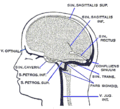 Straight sinus - anatomical illustration
 -
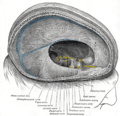 Straight sinus - sagittal section
 -
 Straight sinus - transverse section
 -
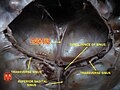 Straight sinus - MRI scan


