Mollusca: Difference between revisions
CSV import |
CSV import |
||
| Line 34: | Line 34: | ||
{{Animalia}} | {{Animalia}} | ||
{{stub}} | {{stub}} | ||
== Mollusca == | |||
<gallery> | |||
File:Mollusca_Diversity.png|Mollusca Diversity | |||
File:Snail-wiki-120-Zachi-Evenor.jpg|Snail | |||
File:Marisa_cornuarietis_,.jpg|Marisa cornuarietis | |||
File:Fossilized_Ammonite_Mollusk_displayed_at_Philippine_National_Museum.jpg|Fossilized Ammonite Mollusk | |||
File:Berlin_Naturkundemuseum_Muscheln.jpg|Berlin Naturkundemuseum Muscheln | |||
File:Cypraea_chinensis_with_partially_extended_mantle.jpg|Cypraea chinensis with partially extended mantle | |||
File:Archimollusc-en.svg|Archimollusc | |||
File:SeaSnails.ogv|Sea Snails | |||
File:Gastropod_nervous_system.gif|Gastropod nervous system | |||
File:Chiton_magnificus.jpg|Chiton magnificus | |||
File:Falcidens_crossotus.jpg|Falcidens crossotus | |||
File:Epimenia_verrucosa.jpg|Epimenia verrucosa | |||
</gallery> | |||
Latest revision as of 21:07, 23 February 2025
Mollusca is a large phylum of invertebrate animals whose members are known as molluscs or mollusks ( ). Around 85,000 extant species of molluscs are recognized. The number of fossil species is estimated between 60,000 and 100,000 additional species.
Characteristics[edit]
Molluscs are the largest marine phylum, comprising about 23% of all the named marine organisms. Numerous molluscs also live in freshwater and terrestrial habitats. They are highly diverse, not just in size and in anatomical structure, but also in behaviour and in habitat. The phylum is typically divided into 9 or 10 taxonomic classes, of which two are entirely extinct.
Anatomy[edit]
Molluscs are characterized by a special type of coelom, a mantle, a radula, and a foot. The coelom is reduced to a small space surrounding the heart in adult molluscs. The mantle is a fold of the outer skin or epidermis, and it encloses the mantle cavity. The radula is a feeding organ, and the foot is used for locomotion.
Classification[edit]
The classification of molluscs has been subject to considerable revision. The system used here is the current system preferred by the Conchologists of America, which is based on the work of Winston Ponder and David Lindberg.
Ecology[edit]
Molluscs play important roles in the ecology of many environments. They are both prey and predator, and they are significant to the human economy.
Human interaction[edit]
Molluscs have been used by humans for food, tools, and as symbols and currency. They are also the cause of significant human diseases.
See also[edit]
References[edit]
<references />
External links[edit]
- Molluscs at The Living World of Molluscs
- Mollusca at University of California Museum of Paleontology
 | |
|---|---|
 |
 |
Mollusca[edit]
-
 Mollusca Diversity
 -
 Snail
Snail -
 Marisa cornuarietis
 -
 Fossilized Ammonite Mollusk
 -
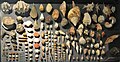 Berlin Naturkundemuseum Muscheln
 -
 Cypraea chinensis with partially extended mantle
 -
 Archimollusc
 -
 Sea Snails
 -
 Gastropod nervous system
 -
 Chiton magnificus
 -
 Falcidens crossotus
 -
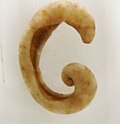 Epimenia verrucosa


