Mass spectrometry: Difference between revisions
CSV import Tags: mobile edit mobile web edit |
CSV import |
||
| Line 32: | Line 32: | ||
{{stub}} | {{stub}} | ||
<gallery> | |||
File:Discovery_of_neon_isotopes.JPG|Discovery of neon isotopes | |||
File:Early_Mass_Spectrometer_(replica).jpg|Early Mass Spectrometer (replica) | |||
File:Alpha_calutron_tank.jpg|Alpha calutron tank | |||
File:Mass_Spectrometer_Schematic.svg|Mass Spectrometer Schematic | |||
File:CARIBU_at_ATLAS.jpg|CARIBU at ATLAS | |||
File:Fenn_ESI_Instrument.jpg|Fenn ESI Instrument | |||
File:ICPMS_Thermo_torch_1.JPG|ICPMS Thermo torch | |||
File:FAB_MS.jpg|FAB MS | |||
File:Orbitrap_mass_analyzer_-_partial_cross-section.JPG|Orbitrap mass analyzer - partial cross-section | |||
File:IonSpec_FT-ICR_(Fourier_transform_Ion_cyclotron_resonance)_Mass_spectrometer.jpg|IonSpec FT-ICR (Fourier transform Ion cyclotron resonance) Mass spectrometer | |||
File:Cont_dynode_detector.jpg|Cont dynode detector | |||
File:TandemMS.svg|Tandem MS | |||
</gallery> | |||
Latest revision as of 11:04, 18 February 2025
Mass spectrometry (MS) is an analytical technique that measures the mass-to-charge ratio of ions. The results are typically presented as a mass spectrum, a plot of intensity as a function of the mass-to-charge ratio. Mass spectrometry is used in many different fields and is applied to pure samples as well as complex mixtures.
History[edit]
The development of mass spectrometry started in the late 19th century with the discovery of Cathode rays by J.J. Thomson. This led to the development of the Mass spectrometer, which separates ions based on their mass-to-charge ratio.
Principles and methods[edit]
Mass spectrometry works by ionizing chemical compounds to generate charged molecules or molecule fragments and measuring their mass-to-charge ratios. The three essential functions of a mass spectrometer, and the associated spectrometer methods, are:
- Ion source
- Mass analyzer
- Detector
Applications[edit]
Mass spectrometry has both qualitative and quantitative uses. These include identifying unknown compounds, determining the isotopic composition of elements in a molecule, and determining the structure of a compound by observing its fragmentation. Other uses include quantifying the amount of a compound in a sample or studying the fundamentals of gas phase ion chemistry (the kinetics and energetics of reactions).
See also[edit]
- List of mass spectrometry methods
- Isotope-ratio mass spectrometry
- Tandem mass spectrometry
- Soft laser desorption
- Fourier-transform ion cyclotron resonance
References[edit]
<references />
External links[edit]
 | |
|---|---|
 |
 |
-
 Discovery of neon isotopes
 -
 Early Mass Spectrometer (replica)
 -
 Alpha calutron tank
 -
 Mass Spectrometer Schematic
 -
 CARIBU at ATLAS
 -
 Fenn ESI Instrument
 -
 ICPMS Thermo torch
 -
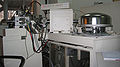 FAB MS
 -
 Orbitrap mass analyzer - partial cross-section
 -
 IonSpec FT-ICR (Fourier transform Ion cyclotron resonance) Mass spectrometer
 -
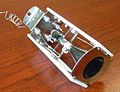 Cont dynode detector
 -
 Tandem MS

.jpg)


_Mass_spectrometer.jpg)


