Geoduck: Difference between revisions
CSV import |
CSV import |
||
| Line 35: | Line 35: | ||
{{stub}} | {{stub}} | ||
{{dictionary-stub1}} | {{dictionary-stub1}} | ||
<gallery> | |||
File:Geoduck_held_in_two_hands.jpg|Geoduck held in two hands | |||
File:Geoduck_Growth_Increments.jpg|Geoduck Growth Increments | |||
File:Jrb_20081127_Mirugai_tsukiji_tokyo_japan_001.JPG|Geoduck at Tsukiji Market, Tokyo, Japan | |||
File:2009_Mollusca_in_Hong_Kong.JPG|Geoduck in Hong Kong | |||
File:Seattle_-_Curiosity_Shop_geoduck_01A.jpg|Geoduck at Curiosity Shop, Seattle | |||
File:Geoduck_before_cooking_at_a_Chinese_restaurant_in_Sunnyvale.jpg|Geoduck before cooking at a Chinese restaurant in Sunnyvale | |||
File:Cooked_geoduck_(right)_at_a_Chinese_restaurant_in_Sunnyvale.jpg|Cooked geoduck at a Chinese restaurant in Sunnyvale | |||
</gallery> | |||
Latest revision as of 12:23, 18 February 2025
Geoduck is a species of large, edible, saltwater clam native to the coastal waters of western Canada and the northwest United States. The geoduck is the largest burrowing clam in the world. It is also one of the longest-living animals of any type, with a typical lifespan of 140 years; the oldest has been recorded at 168 years old.
Description[edit]
The geoduck's shell is thin and oval-shaped, with a small, round opening. The clam's body is soft and siphon-like, extending out of the shell. The siphon, which the clam uses to filter food from the water, can be up to 1 meter in length. The geoduck's body color ranges from white to a light tan.
Habitat[edit]
Geoducks are found in the intertidal zone to depths of 110 meters. They prefer sandy or muddy substrates. Once a geoduck embeds itself into the substrate, it does not move for the rest of its life.
Diet[edit]
Geoducks are filter feeders, siphoning in seawater and filtering out plankton and other microscopic organisms.
Commercial Harvesting[edit]
Geoducks are commercially harvested in both Canada and the United States, primarily for export to Asia where they are considered a delicacy.
Conservation[edit]
Due to their long lifespan and slow growth, geoducks are vulnerable to overharvesting. Management strategies include size limits, seasonal closures, and quotas.
Health Benefits[edit]
Geoducks are a good source of lean protein, and are also high in selenium, iron, and vitamin B12.
See Also[edit]
References[edit]
<references />
 | |
|---|---|
 |
 |
-
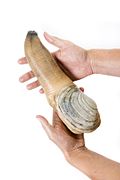 Geoduck held in two hands
 -
 Geoduck Growth Increments
 -
 Geoduck at Tsukiji Market, Tokyo, Japan
 -
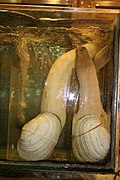 Geoduck in Hong Kong
 -
 Geoduck at Curiosity Shop, Seattle
 -
 Geoduck before cooking at a Chinese restaurant in Sunnyvale
 -
 Cooked geoduck at a Chinese restaurant in Sunnyvale


_at_a_Chinese_restaurant_in_Sunnyvale.jpg)
