Malolactic fermentation: Difference between revisions
CSV import |
CSV import Tags: mobile edit mobile web edit |
||
| Line 19: | Line 19: | ||
{{stub}} | {{stub}} | ||
<gallery> | |||
File:Malolactic_spotting.JPG|Malolactic fermentation | |||
File:Hermann_Müller_(1850-1927).jpg|Hermann Müller (1850-1927) | |||
File:Malolactic_fermentation.svg|Malolactic fermentation | |||
File:Chardonnay-UVa.jpg|Chardonnay grapes | |||
File:O._oeni.jpg|Oenococcus oeni | |||
File:Malolactic_inoculation_and_nutrient.JPG|Malolactic fermentation | |||
File:20101210_014809_LactobacillusBulgaricus.jpg|Lactobacillus bulgaricus | |||
File:Acrolein.svg|Acrolein | |||
File:Sediment_at_bottom_of_wine_barrel.jpg|Sediment at bottom of wine barrel | |||
File:Harvested_grapes_being_loaded_into_crusher_destemmer.jpg|Harvested grapes being loaded into crusher destemmer | |||
File:Transferring_wine_to_a_barrel.png|Transferring wine to a barrel | |||
File:Membrane_filter_without_housing.jpg|Membrane filter without housing | |||
</gallery> | |||
Revision as of 12:08, 18 February 2025
Malolactic fermentation (also known as malolactic conversion or MLF) is a process in winemaking where tart-tasting malic acid, naturally present in grape must, is converted to softer-tasting lactic acid. Malolactic fermentation is most often performed as a secondary fermentation shortly after the primary fermentation, but can sometimes run concurrently with it. The process is standard for most red wine production and common for some white grape varieties such as Chardonnay, where it can impart a "buttery" flavor from diacetyl, a byproduct of the reaction.
Process
The bacteria that perform this conversion are known as lactic acid bacteria (LAB). Species include Oenococcus oeni, Lactobacillus brevis and Pediococcus damnosus. These bacteria are not yeast, and are thus not responsible for primary fermentation which turns sugar into alcohol.
Role in winemaking
Malolactic fermentation tends to create a rounder, fuller mouthfeel. Malic acid is typically associated with the taste of green apples, while lactic acid is richer and more buttery tasting. It also reduces the acidity of the wine, which can make it seem smoother and less tart.
Risks
While malolactic fermentation can improve the flavor profile of the wine, it can also create problems. The process can generate flavors that are generally considered to be off-flavors, such as butyric acid (which smells like rancid butter) and ethyl lactate (which has a solvent-like smell).
See also
 | |
|---|---|
 |
 |
-
 Malolactic fermentation
 -
 Hermann Müller (1850-1927)
 -
 Malolactic fermentation
 -
 Chardonnay grapes
 -
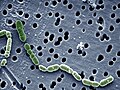 Oenococcus oeni
 -
 Malolactic fermentation
 -
 Lactobacillus bulgaricus
 -
 Acrolein
 -
 Sediment at bottom of wine barrel
 -
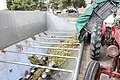 Harvested grapes being loaded into crusher destemmer
 -
 Transferring wine to a barrel
 -
 Membrane filter without housing

.jpg)


