Diffusion: Difference between revisions
From WikiMD's Wellness Encyclopedia
CSV import |
CSV import Tags: mobile edit mobile web edit |
||
| Line 49: | Line 49: | ||
{{stub}} | {{stub}} | ||
{{dictionary-stub1}} | {{dictionary-stub1}} | ||
<gallery> | |||
File:Diffusion.svg|Diffusion | |||
File:Diffusion_v2_20101120.ogv|Diffusion v2 20101120 | |||
File:DiffusionMicroMacro.gif|Diffusion Micro Macro | |||
File:Blausen_0315_Diffusion.png|Blausen 0315 Diffusion | |||
File:Centrotherm_diffusion_furnaces_at_LAAS_0481.jpg|Centrotherm diffusion furnaces at LAAS 0481 | |||
File:Chemical_surface_diffusion_slow.gif|Chemical surface diffusion slow | |||
File:Translational_motion.gif|Translational motion | |||
File:diffusion_center.gif|Diffusion center | |||
File:Semipermeable_membrane_(svg).svg|Semipermeable membrane (svg) | |||
File:Random_motion.webm|Random motion | |||
</gallery> | |||
Latest revision as of 21:05, 23 February 2025
Diffusion is a process that occurs when particles spread out from a high concentration area to a low concentration area. This process is a fundamental concept in the fields of physics, chemistry, and biology.
Overview[edit]
In the context of biology, diffusion is a type of passive transport that allows substances to move in and out of cells. The substances move from an area of high concentration to an area of low concentration, until equilibrium is reached. This process does not require energy, which distinguishes it from active transport.
Types of Diffusion[edit]
There are several types of diffusion, including:
- Simple Diffusion: This is the most basic type of diffusion. It occurs when particles move from a high concentration area to a low concentration area without the help of transport proteins.
- Facilitated Diffusion: This type of diffusion requires the help of transport proteins. These proteins help move substances across the cell membrane.
- Osmosis: This is a special type of diffusion that involves the movement of water molecules across a semi-permeable membrane.
Factors Affecting Diffusion[edit]
Several factors can affect the rate of diffusion, including:
- Concentration Gradient: The difference in concentration between two areas can affect the rate of diffusion. The greater the difference, the faster the rate of diffusion.
- Temperature: Higher temperatures can increase the rate of diffusion as particles move faster at higher temperatures.
- Surface Area: The larger the surface area, the faster the rate of diffusion.
- Distance: The shorter the distance that particles have to move, the faster the rate of diffusion.
Applications of Diffusion[edit]
Diffusion has many applications in various fields, including:
- Medicine: In medicine, diffusion is used in drug delivery systems. Drugs can be designed to diffuse slowly, providing a steady release of medication over time.
- Environmental Science: In environmental science, diffusion is used to understand how pollutants spread in the environment.
- Food Science: In food science, diffusion is used to understand how flavors spread in food.
See Also[edit]
 | |
|---|---|
 |
 |
-
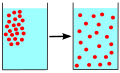 Diffusion
 -
 Diffusion v2 20101120
 -
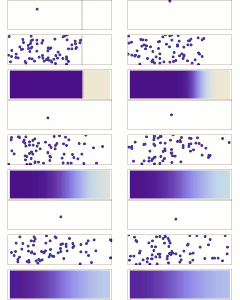 Diffusion Micro Macro
 -
 Blausen 0315 Diffusion
 -
 Centrotherm diffusion furnaces at LAAS 0481
 -
 Chemical surface diffusion slow
 -
 Translational motion
 -
 Diffusion center
 -
 Semipermeable membrane (svg)
 -
 Random motion


.svg)
