First Strike Ration: Difference between revisions
CSV import |
CSV import |
||
| Line 39: | Line 39: | ||
[[Category:United States military rations]] | [[Category:United States military rations]] | ||
<gallery> | |||
File:First_Strike_Ration.jpg|First Strike Ration | |||
File:First_Strike_Ration_Components.jpg|Components of First Strike Ration | |||
File:U.S._Army_soldiers_consuming_First_Strike_Ration.jpg|U.S. Army soldiers consuming First Strike Ration | |||
</gallery> | |||
Latest revision as of 04:06, 18 February 2025
First Strike Ration[edit]
The First Strike Ration (FSR) is a specialized field ration used by the United States Armed Forces. It is designed to provide a compact and lightweight meal option for soldiers during the initial stages of combat operations. The FSR is specifically tailored to meet the nutritional needs of soldiers in high-intensity combat situations.
History[edit]
The development of the First Strike Ration can be traced back to the early 2000s when the U.S. military recognized the need for a ration that could be easily carried and consumed by soldiers during the first 72 hours of combat. The FSR was designed to replace the traditional Meal, Ready-to-Eat (MRE) for these initial stages of combat.
Composition[edit]
The First Strike Ration consists of a variety of food items that are carefully selected to provide a balanced and nutritious meal for soldiers. Each ration typically includes a main entree, side dishes, snacks, and beverages. The food items are packaged in lightweight and durable materials to ensure their freshness and portability.
Some of the commonly included food items in the FSR are:
- Main entrees such as canned meats, pasta dishes, or sandwiches.
- Side dishes like rice, beans, or vegetables.
- Snacks such as energy bars, trail mix, or jerky.
- Beverages like coffee, tea, or sports drinks.
Benefits[edit]
The First Strike Ration offers several advantages over traditional field rations. Its compact size and lightweight nature make it easier for soldiers to carry and transport, especially during the initial stages of combat. The FSR also provides a higher calorie count compared to the standard MRE, ensuring that soldiers receive sufficient energy for their demanding tasks.
Furthermore, the FSR is designed to be consumed without the need for additional preparation or cooking. This allows soldiers to quickly and efficiently consume their meals, saving valuable time during combat operations. The ration's packaging is also designed to be easily opened and resealed, providing convenience and reducing waste.
Usage[edit]
The First Strike Ration is primarily used by the U.S. Army, Marine Corps, and Special Operations Forces. It is typically issued to soldiers during the first 72 hours of combat or in situations where resupply may be limited. The FSR is also utilized in training exercises and field operations where a lightweight and compact ration is required.
See Also[edit]
References[edit]
<references />
-
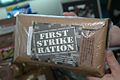 First Strike Ration
 -
 Components of First Strike Ration
 -
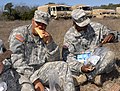 U.S. Army soldiers consuming First Strike Ration


