Cockayne syndrome: Difference between revisions
No edit summary Tag: visualeditor-wikitext |
CSV import |
||
| Line 65: | Line 65: | ||
[[Category:DNA replication and repair-deficiency disorders]] | [[Category:DNA replication and repair-deficiency disorders]] | ||
[[Category:Progeroid syndromes]] | [[Category:Progeroid syndromes]] | ||
== Cockayne_syndrome == | |||
<gallery> | |||
File:A-people-with-cockayne-syndrome.jpg|People with Cockayne syndrome | |||
File:autorecessive.svg|Autosomal recessive inheritance pattern | |||
</gallery> | |||
Revision as of 00:54, 18 February 2025
| Synonyms | N/A |
| Pronounce | |
| Specialty | |
| Symptoms | |
| Complications | |
| Onset | |
| Duration | |
| Types | |
| Causes | |
| Risks | |
| Diagnosis | N/A |
| Differential diagnosis | N/A |
| Prevention | N/A |
| Treatment | N/A |
| Medication | N/A |
| Prognosis | N/A |
| Frequency | N/A |
| Deaths | N/A |
Cockayne syndrome, is a rare and fatal autosomal recessive neurodegenerative disorder characterized by growth failure, impaired development of the nervous system, abnormal sensitivity to sunlight (photosensitivity), eye disorders and premature aging.
Other names
- Neill-Dingwall syndrome
- Cerebro-oculo-facio-skeletal syndrome (COFS)
- Pena Shokeir II Syndrome
Pathophysiology
It is a pediatric, genetic, degenerative disorder that involves the brain and the spinal cord. It is characterized by craniofacial and skeletal abnormalities, severely reduced muscle tone, and impairment of reflexes. Symptoms may include large, low-set ears, small eyes, microcephaly (abnormal smallness of the head), micrognathia (abnormal smallness of the jaws), clenched fists, wide-set nipples, vision impairments, involuntary eye movements, and impaired cognitive development, which can be moderate or severe. Respiratory infections are frequent. COFS is diagnosed at birth. Ultrasound technology can detect fetuses with COFS at an early stage of pregnancy, as the fetus moves very little, and some of the abnormalities result, in part, from lack of movement.
A small number of individuals with COFS have a mutation in the "ERCC6" gene and are more appropriately diagnosed as having Cockayne Syndrome Type II. Other individuals with COFS may have defects in the xeroderma pigmentosumgenes "XPG" or "XPD." Still others who are diagnosed with COFS have no identifiable genetic defect and are presumably affected because of mutations in a distinct, as-yet-unknown gene.
NOTE: This disorder is not the same as Cohen's syndrome (cerebral obesity ocular skeletal syndrome).
Treatment
Treatment is supportive and symptomatic. Individuals with the disorder often require tube feeding. Because COFS is genetic, genetic counseling is available.
Prognosis
COFS is a fatal disease. Most children do not live beyond five years.
- This article incorporates some public domain text from The U.S. National Library of Medicine
| This article is a stub. You can help WikiMD by registering to expand it. |
| Congenital abnormality syndromes | ||||||
|---|---|---|---|---|---|---|
|
| Metabolic disease: DNA replication and DNA repair-deficiency disorder | ||||
|---|---|---|---|---|
|
| Progeroid syndromes | ||||||
|---|---|---|---|---|---|---|
|
Cockayne_syndrome
-
People with Cockayne syndrome
-
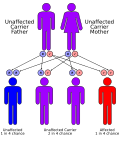 Autosomal recessive inheritance pattern


