Minas Gerais: Difference between revisions
CSV import |
No edit summary |
||
| Line 16: | Line 16: | ||
Tourism in Minas Gerais is centered around its historic towns, natural beauty, and cultural heritage. The state's colonial-era towns, such as [[Ouro Preto]] and [[Diamantina]], are UNESCO World Heritage Sites and popular tourist destinations. The state also boasts several national parks, including the [[Serra do Cipó National Park]] and the [[Caparaó National Park]], which attract visitors with their stunning landscapes and diverse wildlife. | Tourism in Minas Gerais is centered around its historic towns, natural beauty, and cultural heritage. The state's colonial-era towns, such as [[Ouro Preto]] and [[Diamantina]], are UNESCO World Heritage Sites and popular tourist destinations. The state also boasts several national parks, including the [[Serra do Cipó National Park]] and the [[Caparaó National Park]], which attract visitors with their stunning landscapes and diverse wildlife. | ||
== Gallery == | |||
<gallery> | <gallery> | ||
File:Peter Wilhelm Lund with cave paintings.jpg|Peter Wilhelm Lund with cave paintings | File:Peter Wilhelm Lund with cave paintings.jpg|Peter Wilhelm Lund with cave paintings | ||
File:Tanz der Puris (cropped).png|Tanz der Puris | File:Tanz der Puris (cropped).png|Tanz der Puris | ||
| Line 32: | Line 28: | ||
File:Serra da Canstra, parte alta 02.jpg|Serra da Canastra, parte alta | File:Serra da Canstra, parte alta 02.jpg|Serra da Canastra, parte alta | ||
</gallery> | </gallery> | ||
[[Category:States of Brazil]] | |||
[[Category:Minas Gerais]] | |||
{{Brazil-stub}} | |||
{{food-stub}} | |||
Latest revision as of 16:08, 8 March 2025
Minas Gerais is a large inland state in southeastern Brazil, known for its colonial-era towns and natural areas. The capital, Belo Horizonte, is a modern city with a bustling nightlife and a notable art scene, surrounded by mountains.
Geography[edit]
Minas Gerais is the second most populous state in Brazil, after São Paulo. It is bordered by the states of São Paulo, Rio de Janeiro, Espírito Santo, Bahia, Goiás, Mato Grosso do Sul and the Federal District. The state's landscape is characterized by mountains, valleys, and large areas of fertile lands.
History[edit]
The history of Minas Gerais dates back to the early 16th century when the region was inhabited by indigenous tribes. The Portuguese colonized the area in the 17th century, attracted by the potential for gold mining. The state's name, "Minas Gerais," translates to "General Mines," reflecting its rich mining history.
Economy[edit]
Minas Gerais has a diverse economy, with a strong focus on agriculture, mining, and manufacturing. It is one of Brazil's main economic powerhouses, producing a significant portion of the country's total output of milk, coffee, and other agricultural products. The state is also home to several major Brazilian companies, including Vale, one of the world's largest mining companies.
Culture[edit]
The culture of Minas Gerais is a blend of Portuguese, African, and indigenous influences. The state is known for its traditional music, folk dances, and cuisine. The cuisine of Minas Gerais is renowned for its hearty, flavorful dishes, such as feijoada, a black bean stew with pork, and pão de queijo, a popular cheese bread.
Tourism[edit]
Tourism in Minas Gerais is centered around its historic towns, natural beauty, and cultural heritage. The state's colonial-era towns, such as Ouro Preto and Diamantina, are UNESCO World Heritage Sites and popular tourist destinations. The state also boasts several national parks, including the Serra do Cipó National Park and the Caparaó National Park, which attract visitors with their stunning landscapes and diverse wildlife.
Gallery[edit]
-
 Peter Wilhelm Lund with cave paintings
 -
 Tanz der Puris
 -
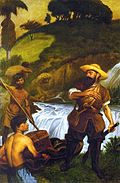 Rodolfo Amoedo - Bandeirante
 -
 Juliao
 -
 Aleijadinho
 -
 Rugendas - Habitans de Minas
 -
 Rugendas - Mattosinho pres Sao Joao Del Rey
 -
 Montanhas da Serra da Mantiqueira
 -
 Serra da Canastra, parte alta

.png)


