Lahpet: Difference between revisions
CSV import |
CSV import |
||
| (One intermediate revision by the same user not shown) | |||
| Line 1: | Line 1: | ||
Lahpet | |||
'''Lahpet''' | [[File:Green_tea_and_peanut_nibbles_(10808703485).jpg|thumb|right|Green tea and peanut nibbles served with lahpet]] | ||
'''Lahpet''' ({{lang-my|လက်ဖက်}}) is a traditional [[Burmese cuisine|Burmese]] dish made from fermented or pickled tea leaves. It is a unique delicacy in [[Myanmar]] and is often served as a snack, salad, or ceremonial dish. Lahpet is deeply embedded in Burmese culture and is considered a symbol of hospitality. | |||
==History== | ==History== | ||
The consumption of lahpet dates back to ancient times in Myanmar, where tea is | |||
The consumption of lahpet dates back to ancient times in Myanmar, where tea is both consumed as a beverage and eaten as a food. The tradition of eating tea leaves is unique to Myanmar, and lahpet has been a part of Burmese culture for centuries. It is often associated with peace offerings and is traditionally served during important social and religious occasions. | |||
==Preparation== | ==Preparation== | ||
[[File:Lahpet_Tasters.JPG|thumb|left|Lahpet tasters sampling different varieties]] | |||
The preparation of lahpet involves fermenting young tea leaves. The leaves are steamed, rolled, and then packed into bamboo vats to ferment. This process can take several months, during which the leaves develop their distinctive flavor and texture. The fermented leaves are then mixed with various ingredients to create different types of lahpet dishes. | |||
==Types of Lahpet== | |||
* | There are several variations of lahpet, each with its own unique flavor profile: | ||
* | |||
* '''Lahpet Thoke''' - A popular salad made with pickled tea leaves, mixed with a variety of ingredients such as garlic, chili, peanuts, and dried shrimp. | |||
* '''A-hlu Lahpet''' - Served during religious ceremonies, often with a selection of nuts and seeds. | |||
[[File:Laphet_thoke.JPG|thumb|right|A traditional serving of Lahpet Thoke]] | |||
==Cultural Significance== | ==Cultural Significance== | ||
Lahpet holds a special place in Burmese culture. It is often served as a gesture of goodwill and is a staple at social gatherings. The phrase "lahpet yei" (tea and lahpet) is synonymous with hospitality in Myanmar. Offering lahpet to guests is a sign of respect and friendship. | |||
==Consumption== | |||
Lahpet is typically consumed as a salad, known as "lahpet thoke," which combines the pickled tea leaves with a variety of crunchy and savory ingredients. It is also served as a snack with green tea, often accompanied by an assortment of nuts and seeds. | |||
[[File:Lahpet_for_sale.jpg|thumb|left|Lahpet for sale in a market]] | |||
==Health Benefits== | ==Health Benefits== | ||
Lahpet is rich in antioxidants due to its tea leaf content. It is believed to aid digestion and provide a boost of energy. However, due to its fermentation process, it is also high in sodium, so it should be consumed in moderation. | Lahpet is rich in antioxidants due to its tea leaf content. It is believed to aid digestion and provide a boost of energy. However, due to its fermentation process, it is also high in sodium, so it should be consumed in moderation. | ||
== | ==Related pages== | ||
* [[Burmese cuisine]] | * [[Burmese cuisine]] | ||
* [[Tea culture]] | * [[Tea culture]] | ||
* [[Fermentation]] | * [[Fermentation]] | ||
[[File:Fried_garnish.JPG|thumb|right|Fried garnishes often served with lahpet]] | |||
==Gallery== | |||
<gallery> | |||
File:Lahpet_in_bulk.JPG|Lahpet sold in bulk | |||
File:Pickled_Tea_&_Ginger_Salad.JPG|Pickled tea and ginger salad | |||
File:Palaung_depiction,_1900s.jpg|Historical depiction of Palaung people, known for tea cultivation | |||
</gallery> | |||
[[Category:Burmese cuisine]] | [[Category:Burmese cuisine]] | ||
[[Category:Fermented foods]] | |||
[[Category:Tea]] | [[Category:Tea]] | ||
Latest revision as of 14:14, 21 February 2025
Lahpet
.jpg)
Lahpet (Burmese: လက်ဖက်) is a traditional Burmese dish made from fermented or pickled tea leaves. It is a unique delicacy in Myanmar and is often served as a snack, salad, or ceremonial dish. Lahpet is deeply embedded in Burmese culture and is considered a symbol of hospitality.
History[edit]
The consumption of lahpet dates back to ancient times in Myanmar, where tea is both consumed as a beverage and eaten as a food. The tradition of eating tea leaves is unique to Myanmar, and lahpet has been a part of Burmese culture for centuries. It is often associated with peace offerings and is traditionally served during important social and religious occasions.
Preparation[edit]

The preparation of lahpet involves fermenting young tea leaves. The leaves are steamed, rolled, and then packed into bamboo vats to ferment. This process can take several months, during which the leaves develop their distinctive flavor and texture. The fermented leaves are then mixed with various ingredients to create different types of lahpet dishes.
Types of Lahpet[edit]
There are several variations of lahpet, each with its own unique flavor profile:
- Lahpet Thoke - A popular salad made with pickled tea leaves, mixed with a variety of ingredients such as garlic, chili, peanuts, and dried shrimp.
- A-hlu Lahpet - Served during religious ceremonies, often with a selection of nuts and seeds.

Cultural Significance[edit]
Lahpet holds a special place in Burmese culture. It is often served as a gesture of goodwill and is a staple at social gatherings. The phrase "lahpet yei" (tea and lahpet) is synonymous with hospitality in Myanmar. Offering lahpet to guests is a sign of respect and friendship.
Consumption[edit]
Lahpet is typically consumed as a salad, known as "lahpet thoke," which combines the pickled tea leaves with a variety of crunchy and savory ingredients. It is also served as a snack with green tea, often accompanied by an assortment of nuts and seeds.

Health Benefits[edit]
Lahpet is rich in antioxidants due to its tea leaf content. It is believed to aid digestion and provide a boost of energy. However, due to its fermentation process, it is also high in sodium, so it should be consumed in moderation.
Related pages[edit]

Gallery[edit]
-
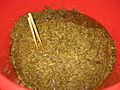 Lahpet sold in bulk
 -
 Pickled tea and ginger salad
 -
 Historical depiction of Palaung people, known for tea cultivation


