Kinase: Difference between revisions
CSV import |
CSV import |
||
| Line 1: | Line 1: | ||
== Kinase == | |||
[[File:Basic_phosphorylation_reaction.png|thumb|right|Basic phosphorylation reaction catalyzed by kinases.]] | |||
A '''kinase''' is an [[enzyme]] that catalyzes the transfer of a [[phosphate group]] from a high-energy molecule, such as [[adenosine triphosphate]] (ATP), to a specific substrate. This process is known as [[phosphorylation]], and it is a crucial mechanism in various cellular processes, including [[signal transduction]], [[metabolism]], and [[cell cycle]] regulation. | |||
== Function == | |||
Kinases play a pivotal role in the regulation of cellular activities. By adding phosphate groups to proteins and other molecules, they can activate or deactivate enzymes, alter protein function, and regulate cellular pathways. This modification can affect the activity, localization, and interaction of proteins, thereby influencing cellular processes. | |||
== Types of Kinases == | |||
Kinases are classified based on the substrate they phosphorylate: | Kinases are classified based on the substrate they phosphorylate: | ||
* '''[[Protein kinase|Protein kinases]]''': These enzymes phosphorylate the [[amino acid]] residues of proteins, typically [[serine]], [[threonine]], or [[tyrosine]]. | * '''[[Protein kinase|Protein kinases]]''': These enzymes phosphorylate the [[amino acid]] residues of proteins, typically [[serine]], [[threonine]], or [[tyrosine]]. | ||
* '''[[Lipid kinase|Lipid kinases]]''': These kinases phosphorylate lipids, playing a key role in [[cell signaling]] pathways. | |||
* '''[[Carbohydrate kinase|Carbohydrate kinases]]''': These enzymes phosphorylate sugars, which is essential in [[glycolysis]] and other metabolic pathways. | |||
== Historical Background == | |||
[[File:Edwin_G._Krebs.jpg|thumb|left|Edwin G. Krebs, a pioneer in the study of kinases.]] | |||
The discovery of kinases and their role in phosphorylation was significantly advanced by the work of [[Edwin G. Krebs]] and [[Edmond H. Fischer]], who were awarded the [[Nobel Prize in Physiology or Medicine]] in 1992 for their discoveries concerning reversible protein phosphorylation as a biological regulatory mechanism. | |||
== Role in Signal Transduction == | |||
[[File:Signal_transduction_pathways.png|thumb|right|Signal transduction pathways involving kinases.]] | |||
Kinases are integral components of [[signal transduction pathways]], where they relay signals from the cell surface to the interior, resulting in a cellular response. For example, the [[MAPK/ERK pathway]] involves a series of kinases that transmit signals from growth factors to the nucleus, influencing cell division and differentiation. | |||
== Kinases in Metabolism == | |||
[[File:Glycolysis_including_irreversible_steps.png|thumb|left|Kinases play a crucial role in glycolysis.]] | |||
In [[metabolism]], kinases are involved in pathways such as [[glycolysis]], where they catalyze key steps in the conversion of glucose to pyruvate. For instance, [[hexokinase]] and [[phosphofructokinase]] are critical enzymes in the glycolytic pathway. | |||
== Kinases in Disease == | |||
Dysregulation of kinase activity is implicated in various diseases, including [[cancer]], [[diabetes]], and [[neurodegenerative disorders]]. Abnormal kinase activity can lead to uncontrolled cell proliferation, resistance to apoptosis, and other pathological conditions. | |||
== | == Specific Kinase Pathways == | ||
=== MAPK Pathway === | |||
[[File:Components_of_the_MAPK_Pathway.png|thumb|right|Components of the MAPK pathway.]] | |||
The [[MAPK pathway]] is a key signaling cascade that involves a series of kinases, including [[MAP kinase kinase]] (MEK) and [[MAP kinase]] (ERK), which regulate gene expression and cell fate decisions. | |||
=== PI3K Pathway === | |||
[[File:PI3_Kinase.tif|thumb|left|Structure of PI3 kinase.]] | |||
[[File:PI3kinase_mechanism.png|thumb|right|Mechanism of PI3 kinase.]] | |||
The [[PI3K/AKT/mTOR pathway]] is another critical signaling pathway involving [[phosphoinositide 3-kinase]] (PI3K), which is involved in cell growth, proliferation, and survival. Dysregulation of this pathway is often associated with cancer. | |||
[[ | |||
== Related Pages == | |||
* [[Phosphatase]] | * [[Phosphatase]] | ||
* [[Enzyme]] | * [[Enzyme]] | ||
* [[Signal transduction]] | * [[Signal transduction]] | ||
* [[ | * [[Metabolism]] | ||
* [[ | * [[Protein phosphorylation]] | ||
[[Category:Enzymes]] | [[Category:Enzymes]] | ||
[[Category:Signal transduction]] | [[Category:Signal transduction]] | ||
[[Category: | [[Category:Metabolism]] | ||
Latest revision as of 14:18, 21 February 2025
Kinase[edit]

A kinase is an enzyme that catalyzes the transfer of a phosphate group from a high-energy molecule, such as adenosine triphosphate (ATP), to a specific substrate. This process is known as phosphorylation, and it is a crucial mechanism in various cellular processes, including signal transduction, metabolism, and cell cycle regulation.
Function[edit]
Kinases play a pivotal role in the regulation of cellular activities. By adding phosphate groups to proteins and other molecules, they can activate or deactivate enzymes, alter protein function, and regulate cellular pathways. This modification can affect the activity, localization, and interaction of proteins, thereby influencing cellular processes.
Types of Kinases[edit]
Kinases are classified based on the substrate they phosphorylate:
- Protein kinases: These enzymes phosphorylate the amino acid residues of proteins, typically serine, threonine, or tyrosine.
- Lipid kinases: These kinases phosphorylate lipids, playing a key role in cell signaling pathways.
- Carbohydrate kinases: These enzymes phosphorylate sugars, which is essential in glycolysis and other metabolic pathways.
Historical Background[edit]
The discovery of kinases and their role in phosphorylation was significantly advanced by the work of Edwin G. Krebs and Edmond H. Fischer, who were awarded the Nobel Prize in Physiology or Medicine in 1992 for their discoveries concerning reversible protein phosphorylation as a biological regulatory mechanism.
Role in Signal Transduction[edit]

Kinases are integral components of signal transduction pathways, where they relay signals from the cell surface to the interior, resulting in a cellular response. For example, the MAPK/ERK pathway involves a series of kinases that transmit signals from growth factors to the nucleus, influencing cell division and differentiation.
Kinases in Metabolism[edit]

In metabolism, kinases are involved in pathways such as glycolysis, where they catalyze key steps in the conversion of glucose to pyruvate. For instance, hexokinase and phosphofructokinase are critical enzymes in the glycolytic pathway.
Kinases in Disease[edit]
Dysregulation of kinase activity is implicated in various diseases, including cancer, diabetes, and neurodegenerative disorders. Abnormal kinase activity can lead to uncontrolled cell proliferation, resistance to apoptosis, and other pathological conditions.
Specific Kinase Pathways[edit]
MAPK Pathway[edit]

The MAPK pathway is a key signaling cascade that involves a series of kinases, including MAP kinase kinase (MEK) and MAP kinase (ERK), which regulate gene expression and cell fate decisions.
PI3K Pathway[edit]
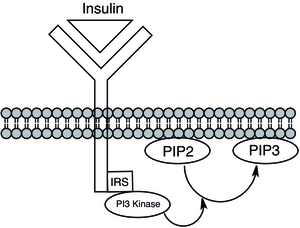
The PI3K/AKT/mTOR pathway is another critical signaling pathway involving phosphoinositide 3-kinase (PI3K), which is involved in cell growth, proliferation, and survival. Dysregulation of this pathway is often associated with cancer.


