Jan Swammerdam: Difference between revisions
CSV import |
CSV import |
||
| Line 34: | Line 34: | ||
[[Category:1637 births]] | [[Category:1637 births]] | ||
[[Category:1680 deaths]] | [[Category:1680 deaths]] | ||
<gallery> | |||
File:Jan_Swammerdam.jpg|Jan Swammerdam | |||
File:Beijer,_Jan_de_(1703-1780),_Afb_010001000416.jpg|Beijer, Jan de (1703-1780) | |||
File:Illustration_of_a_Mosquito_from_Historia_Insectorum_Generalis.jpg|Illustration of a Mosquito from Historia Insectorum Generalis | |||
File:Miraculum_naturae_sive_uteri_muliebris_fabrica_V00115_00000006.tif|Miraculum naturae sive uteri muliebris fabrica | |||
File:Swammerdam,_Jan_–_Bybel_der_Natuure,_1693_–_BEIC_11959684.jpg|Swammerdam, Jan – Bybel der Natuure, 1693 | |||
File:Reproductive_organs_of_the_bee._Wellcome_L0000176.jpg|Reproductive organs of the bee | |||
File:Swammerdam_frog_thigh.PNG|Swammerdam frog thigh | |||
File:Amsterdam_Oudeschans_18_detail.jpg|Amsterdam Oudeschans 18 detail | |||
File:Amsterdam_Oudeschans_18_top.jpg|Amsterdam Oudeschans 18 top | |||
</gallery> | |||
Latest revision as of 21:12, 23 February 2025
Dutch biologist and microscopist
Jan Swammerdam (12 February 1637 – 17 February 1680) was a pioneering Dutch biologist and microscopist who made significant contributions to the fields of entomology and anatomy. He is best known for his meticulous studies of insects and his development of techniques for dissecting and preserving biological specimens.
Early Life and Education[edit]
Jan Swammerdam was born in Amsterdam, in the Dutch Republic, to an affluent family. His father, an apothecary, encouraged his interest in natural history. Swammerdam studied medicine at the University of Leiden, where he was influenced by the work of Franciscus Sylvius and Johannes van Horne. He completed his medical degree in 1667.
Contributions to Entomology[edit]
Swammerdam is renowned for his work in entomology, the study of insects. He was one of the first scientists to use the microscope to study the anatomy of insects in detail. His observations led to the discovery that insects do not undergo spontaneous generation, a common belief at the time. Instead, he demonstrated that insects develop from eggs, a process he meticulously documented.
The "Bible of Nature"[edit]
Swammerdam's most famous work, the "Biblia Naturae" ("Bible of Nature"), was a comprehensive study of insects and other small animals. In this work, he described the life cycles of various insects, including bees, butterflies, and beetles. His detailed illustrations and descriptions provided a foundation for future entomological studies.
Anatomical Studies[edit]
In addition to his work on insects, Swammerdam made significant contributions to the field of anatomy. He was one of the first to use injection techniques to study the circulatory system. Swammerdam's experiments with frogs led to the discovery of the role of muscles in respiration.
The "Swammerdam Experiment"[edit]
One of his notable experiments involved demonstrating that muscles do not increase in volume when they contract, a finding that contradicted the prevailing theories of the time. This experiment, known as the "Swammerdam Experiment," was a significant contribution to the understanding of muscle physiology.
Later Life and Legacy[edit]
Swammerdam's later years were marked by personal struggles and financial difficulties. Despite these challenges, he continued his scientific work until his death in 1680. His contributions to biology and microscopy were not fully appreciated during his lifetime, but his work laid the groundwork for future scientific discoveries.
Swammerdam's meticulous methods and detailed observations set new standards for scientific research. His work influenced later scientists, including Antonie van Leeuwenhoek and Marcello Malpighi. Today, he is remembered as a pioneer in the fields of entomology and anatomy.
Related Pages[edit]
-
 Jan Swammerdam
 -
 Beijer, Jan de (1703-1780)
 -
 Illustration of a Mosquito from Historia Insectorum Generalis
 -
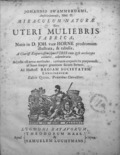 Miraculum naturae sive uteri muliebris fabrica
 -
 Swammerdam, Jan – Bybel der Natuure, 1693
 -
 Reproductive organs of the bee
 -
 Swammerdam frog thigh
 -
 Amsterdam Oudeschans 18 detail
 -
Amsterdam Oudeschans 18 top

,_Afb_010001000416.jpg)


