Germination: Difference between revisions
CSV import |
CSV import |
||
| (One intermediate revision by the same user not shown) | |||
| Line 1: | Line 1: | ||
{{Short description|The process by which a seed develops into a new plant}} | |||
{{For|the process in fungi|Spore germination}} | |||
'''Germination''' is the process by which a seed develops into a new plant. It is a critical phase in the life cycle of [[seed plants]], involving a series of complex physiological and biochemical changes. Germination begins with the uptake of water by the seed, followed by the activation of metabolic pathways that lead to the growth of the [[embryo]] and the emergence of the [[seedling]]. | |||
Germination | |||
== | ==Stages of Germination== | ||
== | ===Imbibition=== | ||
The first stage of germination is '''imbibition''', where the seed absorbs water, swelling and softening the seed coat. This process reactivates the seed's metabolism, which has been dormant during the period of [[seed dormancy]]. Imbibition is crucial as it triggers the enzymatic activities necessary for the subsequent stages of germination. | |||
== | ===Activation of Metabolism=== | ||
Once imbibition occurs, the seed's metabolic pathways are activated. Enzymes such as [[amylase]] and [[protease]] break down stored food reserves in the seed, converting them into energy and building blocks for growth. This stage is marked by increased respiration and the synthesis of new proteins. | |||
===Radicle Emergence=== | |||
The next stage is the emergence of the '''radicle''', the embryonic root, which is the first visible sign of germination. The radicle grows downward into the soil, anchoring the plant and beginning the process of water and nutrient uptake. | |||
===Shoot Emergence=== | |||
Following radicle emergence, the '''shoot''' begins to grow upward, breaking through the soil surface. This stage is critical for the plant to begin [[photosynthesis]], as the shoot carries the [[cotyledons]] or seed leaves, which often contain chlorophyll. | |||
==Factors Affecting Germination== | |||
Several factors influence the germination process, including: | |||
* '''Water''': Essential for imbibition and metabolic activation. | |||
* '''Temperature''': Affects the rate of metabolic reactions; most seeds have an optimal temperature range for germination. | |||
* '''Oxygen''': Required for aerobic respiration, providing energy for growth. | |||
* '''Light''': Some seeds require light to germinate, while others germinate in darkness. | |||
==Types of Germination== | |||
===Epigeal Germination=== | |||
In '''epigeal germination''', the cotyledons are pushed above the soil surface as the hypocotyl elongates. This type is common in plants like [[beans]] and [[sunflowers]]. | |||
===Hypogeal Germination=== | |||
In '''hypogeal germination''', the cotyledons remain below the soil surface, and the epicotyl elongates. This type is seen in plants such as [[peas]] and [[maize]]. | |||
==Importance of Germination== | |||
Germination is vital for the propagation of plant species and the continuation of plant life cycles. It is also crucial for [[agriculture]], as successful germination determines crop yields and food production. | |||
==Related pages== | |||
* [[Seed dormancy]] | * [[Seed dormancy]] | ||
* [[ | * [[Photosynthesis]] | ||
* [[ | * [[Plant physiology]] | ||
* [[Seed dispersal]] | |||
* [[ | |||
[[Category:Plant physiology]] | |||
[[Category:Botany]] | [[Category:Botany]] | ||
== Germination == | |||
<gallery> | <gallery> | ||
File:Sunflower_seedlings.jpg| | File:Sunflower_seedlings.jpg|Sunflower seedlings | ||
File:Sunflower_growing_time_lapse.gif| | File:Sunflower_growing_time_lapse.gif|Sunflower growing time lapse | ||
File:Horticulture_Tray3.jpg| | File:Horticulture_Tray3.jpg|Horticulture tray | ||
File:Sprossenglas.JPG| | File:Sprossenglas.JPG|Sprossenglas | ||
File:Raapstelen_gekiemde_zaden_(Brassica_campestris_germinating_seeds).jpg| | File:Raapstelen_gekiemde_zaden_(Brassica_campestris_germinating_seeds).jpg|Brassica campestris germinating seeds | ||
File:Mung_bean_germination.ogv| | File:Mung_bean_germination.ogv|Mung bean germination | ||
File:Seed_Germination.png| | File:Seed_Germination.png|Seed germination | ||
File:Sjb_whiskey_malt.jpg| | File:Sjb_whiskey_malt.jpg|Whiskey malt | ||
File:Seedling_of_Eucalyptus.jpg| | File:Seedling_of_Eucalyptus.jpg|Seedling of Eucalyptus | ||
File:Stages_of_germination_in_pea_plants.svg| | File:Stages_of_germination_in_pea_plants.svg|Stages of germination in pea plants | ||
File:3D-visualization_of_Aspergillus_niger_spore_germination.gif| | File:3D-visualization_of_Aspergillus_niger_spore_germination.gif|3D visualization of Aspergillus niger spore germination | ||
</gallery> | </gallery> | ||
Latest revision as of 21:38, 23 February 2025
The process by which a seed develops into a new plant
Germination is the process by which a seed develops into a new plant. It is a critical phase in the life cycle of seed plants, involving a series of complex physiological and biochemical changes. Germination begins with the uptake of water by the seed, followed by the activation of metabolic pathways that lead to the growth of the embryo and the emergence of the seedling.
Stages of Germination[edit]
Imbibition[edit]
The first stage of germination is imbibition, where the seed absorbs water, swelling and softening the seed coat. This process reactivates the seed's metabolism, which has been dormant during the period of seed dormancy. Imbibition is crucial as it triggers the enzymatic activities necessary for the subsequent stages of germination.
Activation of Metabolism[edit]
Once imbibition occurs, the seed's metabolic pathways are activated. Enzymes such as amylase and protease break down stored food reserves in the seed, converting them into energy and building blocks for growth. This stage is marked by increased respiration and the synthesis of new proteins.
Radicle Emergence[edit]
The next stage is the emergence of the radicle, the embryonic root, which is the first visible sign of germination. The radicle grows downward into the soil, anchoring the plant and beginning the process of water and nutrient uptake.
Shoot Emergence[edit]
Following radicle emergence, the shoot begins to grow upward, breaking through the soil surface. This stage is critical for the plant to begin photosynthesis, as the shoot carries the cotyledons or seed leaves, which often contain chlorophyll.
Factors Affecting Germination[edit]
Several factors influence the germination process, including:
- Water: Essential for imbibition and metabolic activation.
- Temperature: Affects the rate of metabolic reactions; most seeds have an optimal temperature range for germination.
- Oxygen: Required for aerobic respiration, providing energy for growth.
- Light: Some seeds require light to germinate, while others germinate in darkness.
Types of Germination[edit]
Epigeal Germination[edit]
In epigeal germination, the cotyledons are pushed above the soil surface as the hypocotyl elongates. This type is common in plants like beans and sunflowers.
Hypogeal Germination[edit]
In hypogeal germination, the cotyledons remain below the soil surface, and the epicotyl elongates. This type is seen in plants such as peas and maize.
Importance of Germination[edit]
Germination is vital for the propagation of plant species and the continuation of plant life cycles. It is also crucial for agriculture, as successful germination determines crop yields and food production.
Related pages[edit]
Germination[edit]
-
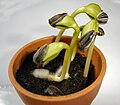 Sunflower seedlings
 -
 Sunflower growing time lapse
 -
 Horticulture tray
 -
 Sprossenglas
 -
 Brassica campestris germinating seeds
 -
 Mung bean germination
 -
 Seed germination
 -
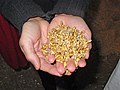 Whiskey malt
 -
 Seedling of Eucalyptus
 -
 Stages of germination in pea plants
 -
 3D visualization of Aspergillus niger spore germination


.jpg)


