Garcinia indica: Difference between revisions
CSV import |
CSV import |
||
| (One intermediate revision by the same user not shown) | |||
| Line 1: | Line 1: | ||
Garcinia indica | |||
[[File:Garcinia_indica_-_fruits,_seeds,_pulp_and_rinds.jpg|thumb|right|Garcinia indica fruits, seeds, pulp, and rinds]] | |||
'''Garcinia indica''', commonly known as kokum, is a tropical evergreen tree that belongs to the family [[Clusiaceae]]. It is native to the Western Ghats region of India and is well known for its culinary and medicinal uses. | |||
==Description== | ==Description== | ||
Garcinia indica is a | [[File:Kokum_Plant.jpg|thumb|left|Kokum plant]] | ||
Garcinia indica is a small to medium-sized tree that can grow up to 18 meters in height. The leaves are dark green, glossy, and oblong. The tree produces small, round fruits that are deep purple when ripe. The fruit contains seeds surrounded by a fleshy pulp. | |||
==Uses== | |||
==Culinary | ===Culinary Uses=== | ||
The fruit of | [[File:Kokumfruitsdried.jpg|thumb|right|Dried kokum fruits]] | ||
The fruit of Garcinia indica is used in cooking, particularly in the [[cuisine of India]]. The dried rind is used as a souring agent in curries and other dishes. It is also used to make a refreshing drink known as kokum sherbet. | |||
==Medicinal | ===Medicinal Uses=== | ||
Garcinia indica has been used | Garcinia indica has been traditionally used in [[Ayurveda]] for its health benefits. It is believed to aid digestion, reduce inflammation, and help in weight management. | ||
== | ==Cultivation== | ||
Garcinia indica is cultivated in the [[Western Ghats]] and other parts of India. It thrives in tropical climates with high humidity and well-drained soil. | |||
== | ==Processing== | ||
[[File:Garcinia_indica_syrup_making_from_rinds.jpg|thumb|left|Syrup making from Garcinia indica rinds]] | |||
The fruits are harvested and the rinds are separated and dried. The dried rinds are then used to make various products, including syrups and extracts. | |||
== | ==Cultural Significance== | ||
Garcinia indica holds cultural importance in the regions where it is grown. It is often used in traditional ceremonies and festivals. | |||
==Gallery== | |||
<gallery> | <gallery> | ||
File:ಮುರುಗಲ_ಹಣ್ಣು.jpg|Kokum fruit | |||
File:Kokam_Fruit_Recipe_with_Sugar_Garcinia_indica_fruit.jpg|Kokum fruit recipe with sugar | |||
File:Garcinia_indica_fruit.jpg|Garcinia indica fruit | |||
File:Garcinia_indica_red_drink_prepared_from_dried_rinds.jpg|Red drink prepared from dried rinds | |||
File:ಮುರುಗಲ_ಹಣ್ಣು.jpg| | |||
File:Kokam_Fruit_Recipe_with_Sugar_Garcinia_indica_fruit.jpg| | |||
File:Garcinia_indica_fruit.jpg|Garcinia indica | |||
File:Garcinia_indica_red_drink_prepared_from_dried_rinds.jpg| | |||
</gallery> | </gallery> | ||
==Related pages== | |||
* [[Clusiaceae]] | |||
* [[Ayurveda]] | |||
* [[Western Ghats]] | |||
[[Category:Clusiaceae]] | |||
[[Category:Flora of India]] | |||
[[Category:Medicinal plants]] | |||
Latest revision as of 14:13, 21 February 2025
Garcinia indica

Garcinia indica, commonly known as kokum, is a tropical evergreen tree that belongs to the family Clusiaceae. It is native to the Western Ghats region of India and is well known for its culinary and medicinal uses.
Description[edit]

Garcinia indica is a small to medium-sized tree that can grow up to 18 meters in height. The leaves are dark green, glossy, and oblong. The tree produces small, round fruits that are deep purple when ripe. The fruit contains seeds surrounded by a fleshy pulp.
Uses[edit]
Culinary Uses[edit]

The fruit of Garcinia indica is used in cooking, particularly in the cuisine of India. The dried rind is used as a souring agent in curries and other dishes. It is also used to make a refreshing drink known as kokum sherbet.
Medicinal Uses[edit]
Garcinia indica has been traditionally used in Ayurveda for its health benefits. It is believed to aid digestion, reduce inflammation, and help in weight management.
Cultivation[edit]
Garcinia indica is cultivated in the Western Ghats and other parts of India. It thrives in tropical climates with high humidity and well-drained soil.
Processing[edit]

The fruits are harvested and the rinds are separated and dried. The dried rinds are then used to make various products, including syrups and extracts.
Cultural Significance[edit]
Garcinia indica holds cultural importance in the regions where it is grown. It is often used in traditional ceremonies and festivals.
Gallery[edit]
-
 Kokum fruit
 -
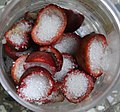 Kokum fruit recipe with sugar
 -
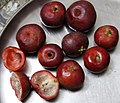 Garcinia indica fruit
 -
 Red drink prepared from dried rinds


