Cardoon: Difference between revisions
CSV import |
CSV import |
||
| (One intermediate revision by the same user not shown) | |||
| Line 1: | Line 1: | ||
== Cardoon == | |||
[[File:Costa_Vicentina_4.jpg|thumb|right|Cardoon growing in the wild]] | |||
The '''cardoon''' (''Cynara cardunculus'') is a thistle-like perennial plant in the family [[Asteraceae]]. It is native to the Mediterranean region and is cultivated for its edible leaf stalks and roots. The cardoon is closely related to the [[artichoke]], and both plants are known for their large, spiny leaves and purple flowers. | |||
== | == Description == | ||
[[File:Cynara_cardunculus_-_Royal_Botanical_Garden,_Madrid.JPG|thumb|left|Cardoon in the Royal Botanical Garden, Madrid]] | |||
Cardoon | |||
The cardoon is a robust plant that can grow up to 1.5 meters in height. It has deeply lobed, silvery-grey leaves that are covered with fine hairs. The plant produces large, purple flower heads that resemble those of the artichoke. The flowers are surrounded by spiny bracts, which protect the developing seeds. | |||
The cardoon | |||
== | == Cultivation == | ||
== | [[File:Cynara_cardunculus_MHNT.BOT.2012.10.18.jpg|thumb|right|Cardoon specimen]] | ||
* [[ | |||
Cardoons are typically grown in well-drained soil with full sun exposure. They require a long growing season and are often blanched to improve the tenderness of the leaf stalks. Blanching involves covering the stalks with soil or opaque material to exclude light, which reduces bitterness and enhances flavor. | |||
== Uses == | |||
[[File:Cynara_cardunculus2.JPG|thumb|left|Close-up of cardoon leaves]] | |||
The cardoon is primarily grown for its edible parts, which include the leaf stalks and roots. The stalks are often used in Mediterranean cuisine, where they are boiled or braised and served as a vegetable. The roots can also be cooked and eaten, although they are less commonly used. | |||
== Medicinal Properties == | |||
[[File:Cynara_cardunculus0.jpg|thumb|right|Cardoon flower]] | |||
Cardoons have been used in traditional medicine for their potential health benefits. They contain compounds that may aid in digestion and liver function. The plant is also a source of [[inulin]], a type of dietary fiber that can promote gut health. | |||
== Environmental Impact == | |||
[[File:Cynara_cardunculus_Prague_2011_1.jpg|thumb|left|Cardoon in Prague]] | |||
Cardoons can become invasive in some regions outside their native range. They are known to spread rapidly and can outcompete native vegetation. In some areas, they are considered a weed and are subject to control measures. | |||
== Related Pages == | |||
* [[Artichoke]] | |||
* [[Asteraceae]] | * [[Asteraceae]] | ||
* [[Mediterranean cuisine]] | * [[Mediterranean cuisine]] | ||
== Gallery == | |||
<gallery> | <gallery> | ||
File:Cardoon_Bud_--_Cynara_cardunculus.jpg|Cardoon bud | |||
File:Cynaracardunculus.jpg|Cardoon plant | |||
File:Cardoon_Bud_--_Cynara_cardunculus.jpg|Cardoon | |||
File:Cynaracardunculus.jpg|Cardoon | |||
</gallery> | </gallery> | ||
[[Category:Asteraceae]] | |||
[[Category:Edible plants]] | |||
[[Category:Invasive plant species]] | |||
Latest revision as of 14:14, 21 February 2025
Cardoon[edit]

The cardoon (Cynara cardunculus) is a thistle-like perennial plant in the family Asteraceae. It is native to the Mediterranean region and is cultivated for its edible leaf stalks and roots. The cardoon is closely related to the artichoke, and both plants are known for their large, spiny leaves and purple flowers.
Description[edit]

The cardoon is a robust plant that can grow up to 1.5 meters in height. It has deeply lobed, silvery-grey leaves that are covered with fine hairs. The plant produces large, purple flower heads that resemble those of the artichoke. The flowers are surrounded by spiny bracts, which protect the developing seeds.
Cultivation[edit]

Cardoons are typically grown in well-drained soil with full sun exposure. They require a long growing season and are often blanched to improve the tenderness of the leaf stalks. Blanching involves covering the stalks with soil or opaque material to exclude light, which reduces bitterness and enhances flavor.
Uses[edit]

The cardoon is primarily grown for its edible parts, which include the leaf stalks and roots. The stalks are often used in Mediterranean cuisine, where they are boiled or braised and served as a vegetable. The roots can also be cooked and eaten, although they are less commonly used.
Medicinal Properties[edit]

Cardoons have been used in traditional medicine for their potential health benefits. They contain compounds that may aid in digestion and liver function. The plant is also a source of inulin, a type of dietary fiber that can promote gut health.
Environmental Impact[edit]

Cardoons can become invasive in some regions outside their native range. They are known to spread rapidly and can outcompete native vegetation. In some areas, they are considered a weed and are subject to control measures.
Related Pages[edit]
Gallery[edit]
-
 Cardoon bud
 -
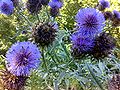 Cardoon plant


