American Viticultural Area: Difference between revisions
CSV import |
CSV import |
||
| Line 4: | Line 4: | ||
File:Paso_Robles_AVA.jpg|Paso Robles AVA | File:Paso_Robles_AVA.jpg|Paso Robles AVA | ||
</gallery> | </gallery> | ||
== American Viticultural Area == | |||
An '''American Viticultural Area''' ('''AVA''') is a designated wine grape-growing region in the United States, distinguishable by geographic features, with boundaries defined by the [[Alcohol and Tobacco Tax and Trade Bureau]] (TTB). AVAs are used on wine labels to indicate the origin of the grapes used in the wine, which can influence the wine's characteristics and quality. | |||
== History == | |||
The concept of AVAs was established in 1980 with the creation of the [[Augusta AVA]] in [[Missouri]], the first recognized AVA. The system was developed to provide a framework similar to the [[Appellation d'origine contrôlée]] (AOC) in [[France]], allowing consumers to identify the geographic origin of wines and to ensure that wines labeled with a specific AVA meet certain standards. | |||
== Criteria for Designation == | |||
To establish an AVA, a petition must be submitted to the TTB. The petition must include: | |||
* Evidence that the name of the proposed AVA is locally or nationally known as referring to the area. | |||
* Historical or current evidence that the boundaries of the AVA are distinct from surrounding areas. | |||
* A description of the geographic features that affect viticulture, such as climate, soil, elevation, and physical features. | |||
== Importance of AVAs == | |||
AVAs are important for both producers and consumers. For producers, AVAs allow them to market their wines based on the unique characteristics of the region. For consumers, AVAs provide information about the origin of the wine, which can be an indicator of quality and style. | |||
== Examples of AVAs == | |||
There are over 260 AVAs in the United States, with some of the most notable including: | |||
* [[Napa Valley AVA]] - Known for its premium [[Cabernet Sauvignon]] and [[Chardonnay]] wines. | |||
* [[Sonoma County AVA]] - Diverse in climate and soil, producing a wide range of varietals. | |||
* [[Willamette Valley AVA]] - Renowned for its [[Pinot Noir]] wines. | |||
* [[Columbia Valley AVA]] - The largest AVA in [[Washington State]], known for its [[Riesling]] and [[Merlot]]. | |||
== Related Pages == | |||
* [[Wine regions of the United States]] | |||
* [[Appellation d'origine contrôlée]] | |||
* [[Terroir]] | |||
* [[Wine labeling regulations]] | |||
{{Wine}} | |||
[[Category:Wine regions of the United States]] | |||
[[Category:American Viticultural Areas]] | |||
Latest revision as of 00:40, 19 February 2025
-
 Solomon Hills Rose
 -
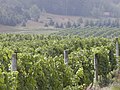 Michigan Chardonnay Vineyard
 -
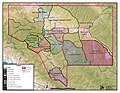 Paso Robles AVA
.jpg)


American Viticultural Area[edit]
An American Viticultural Area (AVA) is a designated wine grape-growing region in the United States, distinguishable by geographic features, with boundaries defined by the Alcohol and Tobacco Tax and Trade Bureau (TTB). AVAs are used on wine labels to indicate the origin of the grapes used in the wine, which can influence the wine's characteristics and quality.
History[edit]
The concept of AVAs was established in 1980 with the creation of the Augusta AVA in Missouri, the first recognized AVA. The system was developed to provide a framework similar to the Appellation d'origine contrôlée (AOC) in France, allowing consumers to identify the geographic origin of wines and to ensure that wines labeled with a specific AVA meet certain standards.
Criteria for Designation[edit]
To establish an AVA, a petition must be submitted to the TTB. The petition must include:
- Evidence that the name of the proposed AVA is locally or nationally known as referring to the area.
- Historical or current evidence that the boundaries of the AVA are distinct from surrounding areas.
- A description of the geographic features that affect viticulture, such as climate, soil, elevation, and physical features.
Importance of AVAs[edit]
AVAs are important for both producers and consumers. For producers, AVAs allow them to market their wines based on the unique characteristics of the region. For consumers, AVAs provide information about the origin of the wine, which can be an indicator of quality and style.
Examples of AVAs[edit]
There are over 260 AVAs in the United States, with some of the most notable including:
- Napa Valley AVA - Known for its premium Cabernet Sauvignon and Chardonnay wines.
- Sonoma County AVA - Diverse in climate and soil, producing a wide range of varietals.
- Willamette Valley AVA - Renowned for its Pinot Noir wines.
- Columbia Valley AVA - The largest AVA in Washington State, known for its Riesling and Merlot.
