Alternaria solani: Difference between revisions
CSV import |
CSV import |
||
| Line 3: | Line 3: | ||
File:Alternaria_solani_-_stem_lesions.jpg|Stem lesions caused by Alternaria solani | File:Alternaria_solani_-_stem_lesions.jpg|Stem lesions caused by Alternaria solani | ||
</gallery> | </gallery> | ||
==Alternaria solani== | |||
'''Alternaria solani''' is a fungal pathogen that causes early blight in [[Solanum lycopersicum|tomatoes]] and [[Solanum tuberosum|potatoes]]. It is a member of the [[Ascomycota]] division and is known for its ability to cause significant agricultural damage, leading to reduced crop yields. | |||
==Description== | |||
Alternaria solani is characterized by its dark, velvety spores and septate hyphae. The conidia are typically oblong to ellipsoid, with transverse and longitudinal septa, giving them a distinctive appearance under a microscope. The fungus thrives in warm, humid conditions, which are conducive to its growth and sporulation. | |||
==Life Cycle== | |||
The life cycle of Alternaria solani involves both asexual and sexual reproduction, although the asexual stage is more commonly observed. The fungus overwinters in plant debris and soil, where it survives as mycelium or conidia. In the presence of favorable environmental conditions, such as high humidity and temperatures between 24-29°C, the conidia germinate and infect host plants. | |||
The pathogen primarily infects through natural openings or wounds in the plant tissue. Once inside, it colonizes the host, leading to the development of characteristic symptoms. | |||
==Symptoms== | |||
Early blight caused by Alternaria solani is identified by the presence of concentric rings on the leaves, stems, and fruits of infected plants. These lesions are often described as "target spots" due to their bullseye appearance. Infected leaves may yellow and drop prematurely, leading to defoliation and reduced photosynthetic capacity. | |||
On tomato fruits, the pathogen causes dark, sunken lesions, which can lead to fruit rot. In potatoes, the fungus can infect tubers, causing dry, corky rot. | |||
==Management== | |||
Managing Alternaria solani involves an integrated approach that includes cultural, chemical, and biological strategies. Crop rotation and the removal of plant debris can reduce the inoculum in the field. Resistant cultivars, when available, should be used to minimize disease impact. | |||
Fungicides are commonly employed to control early blight, with applications timed to coincide with periods of high disease pressure. Biological control agents, such as antagonistic fungi and bacteria, are also being explored as sustainable management options. | |||
==Related Pages== | |||
* [[Early blight]] | |||
* [[Fungal plant pathogens]] | |||
* [[Plant pathology]] | |||
* [[Integrated pest management]] | |||
{{Fungal plant pathogens}} | |||
[[Category:Fungal plant pathogens]] | |||
[[Category:Ascomycota]] | |||
[[Category:Tomato diseases]] | |||
[[Category:Potato diseases]] | |||
Latest revision as of 00:35, 19 February 2025
-
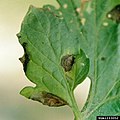 Leaf lesions caused by Alternaria solani
 -
 Stem lesions caused by Alternaria solani


Alternaria solani[edit]
Alternaria solani is a fungal pathogen that causes early blight in tomatoes and potatoes. It is a member of the Ascomycota division and is known for its ability to cause significant agricultural damage, leading to reduced crop yields.
Description[edit]
Alternaria solani is characterized by its dark, velvety spores and septate hyphae. The conidia are typically oblong to ellipsoid, with transverse and longitudinal septa, giving them a distinctive appearance under a microscope. The fungus thrives in warm, humid conditions, which are conducive to its growth and sporulation.
Life Cycle[edit]
The life cycle of Alternaria solani involves both asexual and sexual reproduction, although the asexual stage is more commonly observed. The fungus overwinters in plant debris and soil, where it survives as mycelium or conidia. In the presence of favorable environmental conditions, such as high humidity and temperatures between 24-29°C, the conidia germinate and infect host plants.
The pathogen primarily infects through natural openings or wounds in the plant tissue. Once inside, it colonizes the host, leading to the development of characteristic symptoms.
Symptoms[edit]
Early blight caused by Alternaria solani is identified by the presence of concentric rings on the leaves, stems, and fruits of infected plants. These lesions are often described as "target spots" due to their bullseye appearance. Infected leaves may yellow and drop prematurely, leading to defoliation and reduced photosynthetic capacity.
On tomato fruits, the pathogen causes dark, sunken lesions, which can lead to fruit rot. In potatoes, the fungus can infect tubers, causing dry, corky rot.
Management[edit]
Managing Alternaria solani involves an integrated approach that includes cultural, chemical, and biological strategies. Crop rotation and the removal of plant debris can reduce the inoculum in the field. Resistant cultivars, when available, should be used to minimize disease impact.
Fungicides are commonly employed to control early blight, with applications timed to coincide with periods of high disease pressure. Biological control agents, such as antagonistic fungi and bacteria, are also being explored as sustainable management options.
