Anticucho: Difference between revisions
CSV import |
CSV import |
||
| Line 3: | Line 3: | ||
File:Anticuchos_de_Corazon.jpg|Anticucho | File:Anticuchos_de_Corazon.jpg|Anticucho | ||
</gallery> | </gallery> | ||
==Anticucho== | |||
'''Anticucho''' is a popular dish originating from the [[Andes]] region, particularly associated with [[Peru]] and [[Bolivia]]. It consists of skewered and grilled meat, traditionally made from [[beef heart]]. Anticuchos are a staple of [[street food]] culture in these countries and are often served with a variety of accompaniments. | |||
==History== | |||
The origins of anticucho can be traced back to the pre-Columbian era, where indigenous peoples of the Andes would prepare skewered meats. The dish evolved significantly during the [[Spanish colonization of the Americas]], when [[African slaves]] introduced new cooking techniques and ingredients. The use of beef heart became prevalent due to its availability and affordability. | |||
==Preparation== | |||
Anticuchos are typically prepared by marinating pieces of beef heart in a mixture of [[vinegar]], [[garlic]], [[aji panca]] (a type of red chili pepper), [[cumin]], and other spices. The marinated meat is then skewered on sticks, traditionally made from [[sugarcane]], and grilled over an open flame. The grilling process imparts a smoky flavor to the meat, which is often basted with the marinade during cooking. | |||
==Serving== | |||
Anticuchos are commonly served with boiled [[potatoes]] or [[corn on the cob]]. In Peru, they are often accompanied by a spicy sauce known as [[aji sauce]], which is made from aji peppers, [[cilantro]], and other ingredients. In Bolivia, anticuchos are frequently served with a side of [[llajwa]], a traditional hot sauce. | |||
==Cultural Significance== | |||
Anticuchos hold a significant place in the culinary traditions of Peru and Bolivia. They are especially popular during [[festivals]] and [[celebrations]], where they are enjoyed by people of all ages. The dish is also a symbol of the cultural fusion that characterizes much of South American cuisine, blending indigenous, African, and Spanish influences. | |||
==Variations== | |||
While beef heart is the traditional meat used in anticuchos, variations exist that use other types of meat, such as [[chicken]] or [[pork]]. These variations are often found in urban areas and are adapted to suit different tastes and dietary preferences. | |||
==Related pages== | |||
* [[Peruvian cuisine]] | |||
* [[Bolivian cuisine]] | |||
* [[Street food]] | |||
* [[Grilling]] | |||
{{Cuisine of Peru}} | |||
{{Cuisine of Bolivia}} | |||
[[Category:Peruvian cuisine]] | |||
[[Category:Bolivian cuisine]] | |||
[[Category:Street food]] | |||
Latest revision as of 00:37, 19 February 2025
-
 Anticucho
 -
 Anticucho


Anticucho[edit]
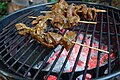
Anticucho is a popular dish originating from the Andes region, particularly associated with Peru and Bolivia. It consists of skewered and grilled meat, traditionally made from beef heart. Anticuchos are a staple of street food culture in these countries and are often served with a variety of accompaniments.
History[edit]
The origins of anticucho can be traced back to the pre-Columbian era, where indigenous peoples of the Andes would prepare skewered meats. The dish evolved significantly during the Spanish colonization of the Americas, when African slaves introduced new cooking techniques and ingredients. The use of beef heart became prevalent due to its availability and affordability.
Preparation[edit]
Anticuchos are typically prepared by marinating pieces of beef heart in a mixture of vinegar, garlic, aji panca (a type of red chili pepper), cumin, and other spices. The marinated meat is then skewered on sticks, traditionally made from sugarcane, and grilled over an open flame. The grilling process imparts a smoky flavor to the meat, which is often basted with the marinade during cooking.
Serving[edit]
Anticuchos are commonly served with boiled potatoes or corn on the cob. In Peru, they are often accompanied by a spicy sauce known as aji sauce, which is made from aji peppers, cilantro, and other ingredients. In Bolivia, anticuchos are frequently served with a side of llajwa, a traditional hot sauce.
Cultural Significance[edit]
Anticuchos hold a significant place in the culinary traditions of Peru and Bolivia. They are especially popular during festivals and celebrations, where they are enjoyed by people of all ages. The dish is also a symbol of the cultural fusion that characterizes much of South American cuisine, blending indigenous, African, and Spanish influences.
Variations[edit]
While beef heart is the traditional meat used in anticuchos, variations exist that use other types of meat, such as chicken or pork. These variations are often found in urban areas and are adapted to suit different tastes and dietary preferences.
