Cachapa: Difference between revisions
CSV import |
CSV import |
||
| Line 28: | Line 28: | ||
[[Category:Venezuelan cuisine]] | [[Category:Venezuelan cuisine]] | ||
[[Category:Maize dishes]] | [[Category:Maize dishes]] | ||
<gallery> | |||
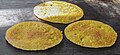
File:Cachapas_from_Venezuela.jpg|Cachapas from Venezuela | |||
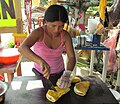
File:Cooking_a_cachapa.jpg|Cooking a cachapa | |||
</gallery> | |||
Latest revision as of 02:04, 17 February 2025
A traditional Venezuelan dish made from corn

Cachapa is a traditional dish from Venezuela, made from a batter of fresh corn. It is similar to a pancake and is often served with various fillings or toppings, such as cheese, meats, or butter. Cachapas are a popular street food and are enjoyed throughout the country.
History[edit]
Cachapas have their origins in the indigenous cultures of Venezuela, where corn has been a staple food for centuries. The dish has evolved over time, incorporating ingredients and techniques from various cultural influences, but it remains a beloved part of Venezuelan cuisine.
Preparation[edit]
Cachapas are made from a simple batter consisting of fresh corn kernels, milk, sugar, and a pinch of salt. The corn is typically ground or blended to form a thick batter. Some recipes may include a small amount of flour or cornmeal to help bind the mixture.
The batter is then poured onto a hot griddle or skillet, forming a thick pancake. It is cooked until golden brown on both sides. Cachapas are traditionally cooked on a budare, a type of flat, round griddle used in Venezuelan cooking.
Serving[edit]
Cachapas are often served with a variety of fillings or toppings. One of the most popular accompaniments is queso de mano, a soft, fresh cheese similar to mozzarella. Other common toppings include butter, ham, or shredded beef.
Cachapas can be enjoyed as a snack, a side dish, or a main course, depending on the size and the accompaniments.
Cultural Significance[edit]
Cachapas are more than just a dish; they are a symbol of Venezuelan culture and hospitality. They are often prepared for family gatherings and celebrations, showcasing the rich agricultural heritage of the country.
Related pages[edit]
-
 Cachapas from Venezuela
 -
 Cooking a cachapa

