Agricultural engineering: Difference between revisions
CSV import |
CSV import |
||
| Line 53: | Line 53: | ||
[[Category:Agriculture]] | [[Category:Agriculture]] | ||
[[Category:Engineering disciplines]] | [[Category:Engineering disciplines]] | ||
<gallery> | |||
File:Irrigation_canal_in_Pisac,_Peru_2019-10-16-1.jpg|Irrigation canal in Pisac, Peru | |||
File:Henry_Herbert_La_Thangue_-_The_Last_Furrow_1895.jpg|The Last Furrow by Henry Herbert La Thangue, 1895 | |||
File:Old_Style_Harvester.jpg|Old Style Harvester | |||
File:Hay_tedder_p.jpg|Hay Tedder | |||
File:Farm._Tractor_-_Farm,_Ville_LaSalle_BAnQ_P48S1P08968.jpg|Farm Tractor in Ville LaSalle | |||
File:Soufli_-_playground,_agricultural_machine.jpg|Agricultural machine in Soufli | |||
</gallery> | |||
Latest revision as of 11:34, 18 February 2025
Agricultural Engineering[edit]

Agricultural engineering is the branch of engineering that deals with the design, construction, and improvement of farming equipment and machinery. It combines the disciplines of mechanical engineering, civil engineering, electrical engineering, and chemical engineering with a knowledge of agricultural principles.
History[edit]
The field of agricultural engineering emerged in the early 20th century as a response to the need for increased agricultural productivity. The development of the tractor and other mechanized equipment revolutionized farming practices, allowing for more efficient cultivation of land.

Key Areas of Agricultural Engineering[edit]
Farm Machinery[edit]
Agricultural engineers design and develop machinery and equipment that are used in farming. This includes tractors, plows, harvesters, and irrigation systems. The goal is to improve efficiency and reduce labor costs.

Soil and Water Engineering[edit]
This area focuses on the management of soil and water resources. Engineers design irrigation systems, drainage systems, and soil conservation structures to optimize the use of water and maintain soil health.
Agricultural Structures[edit]
Agricultural engineers also design structures such as barns, silos, and greenhouses. These structures are designed to protect crops and livestock from the elements and to optimize the conditions for growth and production.
Bioengineering[edit]
Bioengineering in agriculture involves the application of engineering principles to biological systems. This includes the development of biotechnology and genetic engineering techniques to improve crop yields and resistance to pests and diseases.
Modern Developments[edit]
In recent years, agricultural engineering has embraced new technologies such as precision agriculture, which uses GPS and remote sensing to monitor and manage crops. Automation and robotics are also becoming increasingly important in the field, with the development of autonomous tractors and drones for monitoring crop health.
Related Pages[edit]
Gallery[edit]
-
 Hay tedder
 -
 Farm tractor
 -
 Agricultural machine in Soufli


-
 Irrigation canal in Pisac, Peru
 -
 The Last Furrow by Henry Herbert La Thangue, 1895
 -
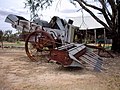 Old Style Harvester
 -
Hay Tedder
-
Farm Tractor in Ville LaSalle
-
Agricultural machine in Soufli
