Abnormal cannabidiol: Difference between revisions
CSV import |
CSV import |
||
| Line 36: | Line 36: | ||
[[Category:Synthetic cannabinoids]] | [[Category:Synthetic cannabinoids]] | ||
[[Category:Cannabinoids]] | [[Category:Cannabinoids]] | ||
== Abnormal_cannabidiol == | |||
<gallery> | |||
File:Abnormal_cannabidiol_structure.png|Chemical structure of Abnormal cannabidiol | |||
File:Abnormal_cannabidiol_3D_BS.png|3D ball-and-stick model of Abnormal cannabidiol | |||
</gallery> | |||
Latest revision as of 02:17, 18 February 2025
Synthetic cannabinoid compound
Abnormal cannabidiol (abn-CBD) is a synthetic compound that is structurally related to cannabidiol (CBD), a naturally occurring constituent of the Cannabis plant. Unlike CBD, abn-CBD does not bind to the classical cannabinoid receptors, such as CB1 and CB2, but it has been shown to interact with other targets in the body, including the GPR55 receptor and the TRPV2 channel.
Chemical structure[edit]
Abnormal cannabidiol is a cannabinoid derivative with a unique structure that distinguishes it from other cannabinoids. The chemical structure of abn-CBD is characterized by the presence of a cyclohexene ring and a pentyl side chain, similar to CBD, but with a different configuration of the hydroxyl groups and the cyclohexene ring.

Pharmacology[edit]
Abnormal cannabidiol has been studied for its potential pharmacological effects, which differ from those of traditional cannabinoids. It does not activate the CB1 or CB2 receptors, which are the primary targets of most cannabinoids. Instead, abn-CBD has been shown to act as an agonist at the GPR55 receptor, a receptor that is involved in various physiological processes, including pain perception and inflammation.
Additionally, abn-CBD has been found to activate the TRPV2 channel, a member of the transient receptor potential channel family, which is involved in the detection of temperature and pain.
Potential therapeutic applications[edit]
Research into abnormal cannabidiol has suggested potential therapeutic applications, particularly in the areas of pain management and neuroprotection. Its ability to modulate GPR55 and TRPV2 channels may offer new avenues for the development of treatments for conditions such as chronic pain, inflammatory diseases, and neurological disorders.
Related compounds[edit]
Abnormal cannabidiol is part of a broader class of synthetic cannabinoids that are being investigated for their unique properties and potential medical benefits. Other related compounds include:
- Cannabidiol (CBD)
- Tetrahydrocannabinol (THC)
- Cannabigerol (CBG)
See also[edit]
Gallery[edit]
-
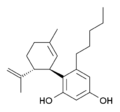 Chemical structure of abnormal cannabidiol
 -
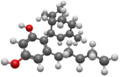 3D ball-and-stick model of abnormal cannabidiol

Abnormal_cannabidiol[edit]
-
Chemical structure of Abnormal cannabidiol
-
3D ball-and-stick model of Abnormal cannabidiol
