6-Phosphogluconate dehydrogenase: Difference between revisions
CSV import |
CSV import |
||
| (One intermediate revision by the same user not shown) | |||
| Line 1: | Line 1: | ||
{{Short description|Enzyme involved in the pentose phosphate pathway}} | |||
{{Enzyme}} | |||
[[ | '''6-Phosphogluconate dehydrogenase''' is an enzyme that plays a crucial role in the [[pentose phosphate pathway]], a metabolic pathway parallel to [[glycolysis]]. This enzyme catalyzes the oxidative decarboxylation of 6-phosphogluconate to [[ribulose 5-phosphate]], producing [[NADPH]] in the process. | ||
[[ | |||
==Structure== | |||
6-Phosphogluconate dehydrogenase is a [[dimeric enzyme]], meaning it consists of two subunits. Each subunit contains a binding site for the substrate, 6-phosphogluconate, and a binding site for the cofactor [[NADP+]]. The enzyme's structure allows it to facilitate the transfer of electrons from 6-phosphogluconate to NADP+, reducing it to NADPH. | |||
== Function == | ==Function== | ||
6- | The primary function of 6-phosphogluconate dehydrogenase is to catalyze the conversion of 6-phosphogluconate into ribulose 5-phosphate. This reaction is an important step in the oxidative phase of the pentose phosphate pathway, which is essential for the production of NADPH and [[ribose 5-phosphate]]. NADPH is a critical reducing agent used in various biosynthetic reactions, including fatty acid synthesis and the maintenance of [[glutathione]] in its reduced form. | ||
== | ==Mechanism== | ||
The enzyme | The enzyme operates through an oxidative decarboxylation mechanism. Initially, 6-phosphogluconate binds to the active site of the enzyme. The enzyme then facilitates the transfer of a hydride ion from the substrate to NADP+, forming NADPH. This is followed by the decarboxylation of the substrate, releasing [[carbon dioxide]] and forming ribulose 5-phosphate. | ||
== | ==Clinical significance== | ||
Deficiencies in 6-phosphogluconate dehydrogenase can lead to disruptions in the pentose phosphate pathway, affecting the production of NADPH. This can have downstream effects on cellular processes that rely on NADPH, such as the detoxification of reactive oxygen species. However, such deficiencies are rare compared to other enzyme deficiencies in the pathway, such as [[glucose-6-phosphate dehydrogenase deficiency]]. | |||
==Related pages== | |||
== Related | |||
* [[Pentose phosphate pathway]] | * [[Pentose phosphate pathway]] | ||
* [[NADPH]] | * [[NADPH]] | ||
* [[Ribulose 5-phosphate]] | * [[Ribulose 5-phosphate]] | ||
* [[ | * [[Glucose-6-phosphate dehydrogenase]] | ||
== Gallery == | ==Gallery== | ||
<gallery> | <gallery> | ||
File:PDB_1pgq_EBI.jpg|Structure of 6-phosphogluconate dehydrogenase | File:PDB_1pgq_EBI.jpg|Structure of 6-phosphogluconate dehydrogenase | ||
File:1pgo.jpg| | File:1pgo.jpg|Crystal structure of the enzyme | ||
</gallery> | </gallery> | ||
[[Category:Enzymes]] | [[Category:Enzymes]] | ||
[[Category:Metabolism]] | [[Category:Metabolism]] | ||
[[Category: | [[Category:Pentose phosphate pathway]] | ||
<gallery> | |||
File:PDB_1pgq_EBI.jpg|Structure of 6-Phosphogluconate dehydrogenase | |||
File:1pgo.jpg|Another view of 6-Phosphogluconate dehydrogenase | |||
</gallery> | |||
Latest revision as of 01:54, 17 February 2025
Enzyme involved in the pentose phosphate pathway
6-Phosphogluconate dehydrogenase
6-Phosphogluconate dehydrogenase is an enzyme that plays a crucial role in the pentose phosphate pathway, a metabolic pathway parallel to glycolysis. This enzyme catalyzes the oxidative decarboxylation of 6-phosphogluconate to ribulose 5-phosphate, producing NADPH in the process.
Structure[edit]
6-Phosphogluconate dehydrogenase is a dimeric enzyme, meaning it consists of two subunits. Each subunit contains a binding site for the substrate, 6-phosphogluconate, and a binding site for the cofactor NADP+. The enzyme's structure allows it to facilitate the transfer of electrons from 6-phosphogluconate to NADP+, reducing it to NADPH.
Function[edit]
The primary function of 6-phosphogluconate dehydrogenase is to catalyze the conversion of 6-phosphogluconate into ribulose 5-phosphate. This reaction is an important step in the oxidative phase of the pentose phosphate pathway, which is essential for the production of NADPH and ribose 5-phosphate. NADPH is a critical reducing agent used in various biosynthetic reactions, including fatty acid synthesis and the maintenance of glutathione in its reduced form.
Mechanism[edit]
The enzyme operates through an oxidative decarboxylation mechanism. Initially, 6-phosphogluconate binds to the active site of the enzyme. The enzyme then facilitates the transfer of a hydride ion from the substrate to NADP+, forming NADPH. This is followed by the decarboxylation of the substrate, releasing carbon dioxide and forming ribulose 5-phosphate.
Clinical significance[edit]
Deficiencies in 6-phosphogluconate dehydrogenase can lead to disruptions in the pentose phosphate pathway, affecting the production of NADPH. This can have downstream effects on cellular processes that rely on NADPH, such as the detoxification of reactive oxygen species. However, such deficiencies are rare compared to other enzyme deficiencies in the pathway, such as glucose-6-phosphate dehydrogenase deficiency.
Related pages[edit]
Gallery[edit]
-
 Structure of 6-phosphogluconate dehydrogenase
 -
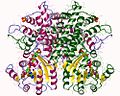 Crystal structure of the enzyme


-
Structure of 6-Phosphogluconate dehydrogenase
-
Another view of 6-Phosphogluconate dehydrogenase
