Lighvan cheese: Difference between revisions
CSV import Tags: mobile edit mobile web edit |
No edit summary |
||
| (One intermediate revision by the same user not shown) | |||
| Line 21: | Line 21: | ||
{{Cheese-stub}} | {{Cheese-stub}} | ||
{{food-stub}} | {{food-stub}} | ||
<gallery> | |||
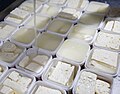
File:Lighvan_cheese_1.jpg|Lighvan cheese | |||
</gallery> | |||
Latest revision as of 00:39, 17 March 2025
Lighvan Cheese is a traditional Iranian cheese originating from the city of Liqvan, a village in the East Azerbaijan Province of Iran. It is one of the most popular cheeses in Iran and is often used in Iranian cuisine.
History[edit]
Lighvan Cheese has a long history dating back to ancient times. The cheese is named after the village of Liqvan, where it was first produced. The traditional method of production has been passed down through generations and is still used today.
Production[edit]
The production of Lighvan Cheese involves a unique process. The cheese is made from sheep's milk or a combination of sheep's and cow's milk. The milk is first heated and then rennet is added to coagulate the milk. The curd is then cut into small pieces and drained in a cloth bag. The cheese is then salted and aged for a period of time.
Characteristics[edit]
Lighvan Cheese is a semi-hard cheese with a creamy texture. It has a strong, tangy flavor and a slightly salty taste. The cheese is white in color and has small holes throughout. It is often eaten fresh, but can also be aged for a stronger flavor.
Uses[edit]
Lighvan Cheese is often used in Iranian cuisine. It can be eaten on its own, or used in a variety of dishes. It is commonly used in salads, sandwiches, and as a topping for traditional Iranian dishes.
See also[edit]


-
 Lighvan cheese

