Typographical error: Difference between revisions
CSV import |
CSV import |
||
| Line 47: | Line 47: | ||
[[Category:Typography]] | [[Category:Typography]] | ||
[[Category:Errors]] | [[Category:Errors]] | ||
<gallery> | |||
File:Titivillus.jpg|Titivillus, the demon of typos | |||
File:Spelling_Correction_Example.jpg|Example of a spelling correction | |||
File:Marked_Wicked_bible.jpg|Marked page from the Wicked Bible | |||
File:Judas_Bible2.jpg|Page from the Judas Bible | |||
</gallery> | |||
Latest revision as of 05:00, 18 February 2025
Typographical Error[edit]
A typographical error, often shortened to typo, is a mistake made in the typing process of printed material. This can occur due to mechanical failure or slip of the hand or finger, but is usually the result of human error. Typographical errors are common in both digital and print media and can range from minor spelling mistakes to significant errors that alter the meaning of the text.

History[edit]
The concept of typographical errors dates back to the early days of printing. In the medieval period, scribes would often make errors while copying texts by hand. With the invention of the printing press by Johannes Gutenberg in the 15th century, the potential for typographical errors increased as texts were reproduced more rapidly.
One of the most famous historical typographical errors is found in the "Wicked Bible" of 1631, where the word "not" was omitted from the commandment "Thou shalt not commit adultery," leading to the text "Thou shalt commit adultery."

Types of Typographical Errors[edit]
Typographical errors can be categorized into several types:
- Misspellings: Incorrect spelling of words, often due to transposition of letters or omission of characters.
- Punctuation errors: Misplacement or absence of punctuation marks.
- Formatting errors: Incorrect use of fonts, sizes, or styles.
- Grammatical errors: Mistakes in grammar that may arise from typographical errors.
Impact[edit]
Typographical errors can have varying impacts depending on the context. In casual communication, such as emails or text messages, typos are often overlooked. However, in professional or academic settings, they can undermine the credibility of the work. In some cases, typographical errors can lead to significant misunderstandings or financial losses.

Prevention and Correction[edit]
To prevent typographical errors, many writers and editors use spell checkers and grammar checkers. Proofreading is also a critical step in the editing process to catch errors that automated tools might miss. In digital media, errors can often be corrected quickly, but in print media, they may require reprinting, which can be costly.
Notable Examples[edit]
- The "Judas Bible" is another example where a typographical error led to a significant alteration in meaning. In this edition, "Judas" was printed instead of "Jesus" in a passage, leading to confusion.

Related Pages[edit]
-
 Titivillus, the demon of typos
 -
 Example of a spelling correction
 -
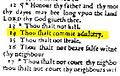 Marked page from the Wicked Bible
 -
 Page from the Judas Bible
