Turpentine: Difference between revisions
CSV import Tags: mobile edit mobile web edit |
CSV import |
||
| Line 42: | Line 42: | ||
[[Category:Solvents]] | [[Category:Solvents]] | ||
[[Category:Organic compounds]] | [[Category:Organic compounds]] | ||
<gallery> | |||
File:Turpentine_distilled_old_way.jpg|Turpentine distilled the old way | |||
File:CupGutterSystem.jpg|Cup and gutter system for collecting turpentine | |||
File:Chipping_a_turpentine_tree.jpg|Chipping a turpentine tree | |||
File:Turpentine_face_Clinch_Co,_GA,_US,_2.jpg|Turpentine face in Clinch County, Georgia, USA | |||
File:PSM_V48_D518_Turpentine_still_at_Manlyn_North_Carolina.jpg|Turpentine still at Manlyn, North Carolina | |||
</gallery> | |||
Latest revision as of 04:43, 18 February 2025
Turpentine[edit]

Turpentine is a fluid obtained by the distillation of resin harvested from living trees, primarily pine trees. It is mainly used as a solvent and as a source of materials for organic synthesis.
Production[edit]

Turpentine is produced by the distillation of resin obtained from trees, mainly pine trees. The resin is collected by making incisions into the tree bark, a process known as "tapping". The resin is then distilled to separate the volatile oil, known as turpentine, from the non-volatile rosin.
Collection[edit]

The collection of resin involves a method called "chipping," where the bark of the tree is cut to allow the resin to flow. A cup and gutter system is often used to collect the resin as it drips from the tree.
Distillation[edit]
The collected resin is then distilled in a still. The process involves heating the resin to evaporate the turpentine, which is then condensed and collected. The remaining solid material is known as rosin.
Uses[edit]
Turpentine is used as a solvent in the production of varnish and paint, and as a raw material in the chemical industry for the synthesis of other compounds. It is also used in traditional medicine and as a cleaning agent.
History[edit]
The use of turpentine dates back to ancient times, where it was used for medicinal purposes and as a solvent. The industry grew significantly in the 19th century, particularly in the southeastern United States, where large pine forests provided an abundant source of resin.
Environmental Impact[edit]
The production of turpentine has environmental impacts, including deforestation and habitat destruction. Sustainable practices and regulations have been implemented to mitigate these effects.
Related pages[edit]
-
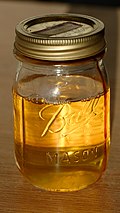 Turpentine distilled the old way
 -
 Cup and gutter system for collecting turpentine
 -
 Chipping a turpentine tree
 -
 Turpentine face in Clinch County, Georgia, USA
 -
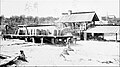 Turpentine still at Manlyn, North Carolina


