Protein design: Difference between revisions
CSV import |
CSV import |
||
| Line 68: | Line 68: | ||
[[Category:Protein engineering]] | [[Category:Protein engineering]] | ||
[[Category:Medical technology]] | [[Category:Medical technology]] | ||
== Protein design gallery == | |||
<gallery> | |||
File:Top7.png|Top7 | |||
File:1FSVblue-1ZAAred.png|1FSV blue - 1ZAA red | |||
File:ileRotamers.gif|Isoleucine Rotamers | |||
File:PEF comparison.png|PEF Comparison | |||
File:Water-hbond-vrc01-gp120.png|Water Hydrogen Bond VRC01 gp120 | |||
File:knowledge based potential.png|Knowledge Based Potential | |||
File:ProteinDesignSearch.gif|Protein Design Search | |||
</gallery> | |||
Latest revision as of 05:11, 3 March 2025
Protein Design[edit]
Protein design is a field of biotechnology that involves the creation of new protein molecules with specific structures and functions. This interdisciplinary field combines principles from molecular biology, biochemistry, bioinformatics, and computational biology to design proteins that can be used in various applications, including medicine, industrial biotechnology, and nanotechnology.
Overview[edit]
Protein design aims to create proteins with novel properties that do not exist in nature. This can involve designing entirely new proteins from scratch (de novo protein design) or modifying existing proteins to enhance their functions or stability. The process typically involves:
- Identifying a target function: Determining the desired activity or property of the protein, such as binding to a specific ligand or catalyzing a particular chemical reaction.
- Designing the protein structure: Using computational tools to predict the three-dimensional structure of the protein that will achieve the target function.
- Synthesizing the protein: Using recombinant DNA technology to produce the designed protein in a laboratory setting.
- Testing and optimization: Experimentally verifying the function of the protein and making necessary adjustments to improve its performance.
Methods[edit]
Computational Design[edit]
Computational methods play a crucial role in protein design. These methods involve the use of algorithms and software to predict protein structures and functions. Key techniques include:
- Molecular modeling: Simulating the physical and chemical properties of proteins to predict their behavior.
- Docking simulations: Predicting how proteins interact with other molecules, such as substrates or inhibitors.
- Energy minimization: Calculating the most stable conformation of a protein by minimizing its free energy.
Directed Evolution[edit]
Directed evolution is an experimental technique used to evolve proteins with desired traits. It involves:
- Generating a library of variants: Creating a diverse set of protein variants through mutagenesis.
- Screening and selection: Identifying variants with improved properties through high-throughput screening methods.
- Iterative optimization: Repeating the process to further enhance the protein's characteristics.
Applications[edit]
Medical Applications[edit]
In medicine, protein design is used to develop new therapeutics and diagnostics. Examples include:
- Enzyme replacement therapies: Designing enzymes to replace deficient or malfunctioning ones in patients with metabolic disorders.
- Antibody engineering: Creating antibodies with enhanced specificity and affinity for use in immunotherapy.
- Vaccine development: Designing protein-based vaccines that elicit strong immune responses.
Industrial Applications[edit]
In industry, designed proteins are used to improve processes and products. Applications include:
- Biocatalysts: Designing enzymes that catalyze industrial reactions more efficiently.
- Biomaterials: Creating proteins that form the basis of new materials with unique properties.
Nanotechnology[edit]
Protein design is also applied in nanotechnology to create nanoscale devices and materials. This includes:
- Nanostructures: Designing proteins that self-assemble into specific shapes for use in drug delivery or biosensing.
Challenges[edit]
Despite its potential, protein design faces several challenges:
- Complexity of protein folding: Accurately predicting how a protein will fold into its functional form remains difficult.
- Stability and solubility: Ensuring that designed proteins are stable and soluble under physiological conditions.
- Functional validation: Experimentally confirming that the designed protein performs the intended function.
Future Directions[edit]
Advancements in artificial intelligence and machine learning are expected to enhance protein design capabilities. These technologies can improve the accuracy of structure prediction and enable the design of more complex proteins.
See Also[edit]

| Biotechnology | ||||||||||
|---|---|---|---|---|---|---|---|---|---|---|
|
Protein design gallery[edit]
-
 Top7
Top7 -
 1FSV blue - 1ZAA red
 -
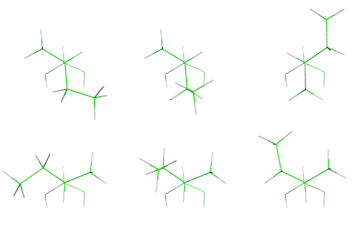 Isoleucine Rotamers
 -
 PEF Comparison
 -
 Water Hydrogen Bond VRC01 gp120
 -
 Knowledge Based Potential
 -
 Protein Design Search


